



News:
Movers & Milestones
Posted: November 25, 2025
Sunrise Multifamily Summit gives 360 Degree view of rental market, economic forces and forecasts
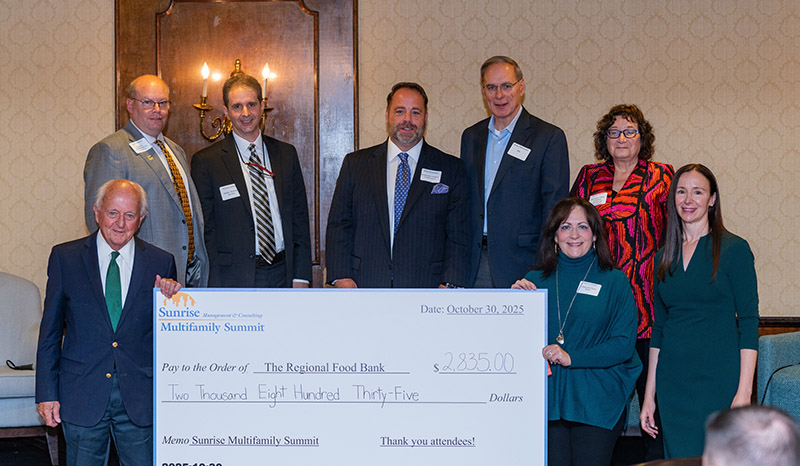
Latham, NY Sunrise Management & Consulting brought together commercial real estate industry leaders on October 30, 2025, for the return of the Sunrise Multifamily Summit.
The program featured a keynote address from renowned economist Hugh Johnson, chairman and chief economist of Hugh Johnson Economics, followed by a panel discussion that painted a landscape of the trends, challenges, opportunities, and advice for multifamily investors in New York’s Capital Region.
The event and the gathering of market-level intelligence could not have occurred at a more pivotal time. After years of volatility, pandemic disruption, inflation spikes, capital cost increases, permitting constraint, and chronic under-building, real estate and banking decision-makers seek clarity – especially now facing the uncertain effects of tariffs, deportation, and immigration policies’ impact on the labor force, and a potential credit crisis.
Economic Cycle Still Supports Multifamily Strength
Hugh Johnson said the financial markets are sending positive indicators aligned with continued economic expansion. “Investors collectively are saying that prospects for the economy are good,” he said. Liquidity conditions are improving, the Federal Reserve reduced short-term rates this fall, and they may do so again in December. Johnson forecast mortgage rates falling below 6% in 2026 and 2027, which would notably improve affordability, activity, and deal volume.
Inflation remains above the Fed’s long-term target, but not at levels that derail the Fed’s path toward gradually lower rates. Earnings growth projections, particularly at the corporate level, remain very strong into 2026–2027. And critically for multifamily: activity levels stay high even when pricing moderates. The combination of strong activity, better affordability over time, and moderate price stabilization continues to support multifamily as a leading asset class.
“I view us as a leading economic indicator,” said Stephen Obermayer, chief financial officer and principal of BBL, “because whenever there is a downturn, the first thing that goes is CapEx (Capital Expenditures) commitments. Right now, there’s a lot of larger projects moving forward… so {the commercial real estate market} is very strong.”

Supply, Demand, and No Saturation in Sight
Panelists agreed: There is simply not enough housing supply being delivered in this region to match current or future demand. “We haven’t built enough housing in the Capital Region for at least the last decade,” said Jesse Holland, president of Sunrise Management & Consulting, which currently manages approximately 1,200 units, with another 600 in the pipeline.
“Even large new projects don’t make a dent,” said Brian Sheldrick, senior vice president of business services at Broadview Federal Credit Union. “Lease velocity has been tremendous -- especially new {units}: It’s astounding how quickly they are filling.” He reiterated the long horizon of rental demand, especially as homeownership affordability continues to erode. Household formation, delayed home buying, longer life expectancy, and rising incomes from regional economic drivers (including tech, chips, health, engineering, and higher ed) are all bolstering high multifamily demand.
One proven model for expanding housing opportunity – particularly in urban areas – is the (federal and state) Historic Preservation Tax Credit for rehabilitating historic buildings,” Obermayer said. “The economic benefits are in the hundreds of millions while restoring the character of cities – and most of the time it creates more units.”
 Development Costs a Challenge
“I would describe multifamily as strong – but challenging,” Holland said. “There are certainly some headwinds that we deal with: the law changes in 2019 that were definitely anti-landlord and that drum still beats.”
Permitting timelines, wetlands rules, and code shifts further create friction, especially when project approvals hinge on boards that meet only once per month. Even modest redesign requests can add months or years to delivery.
Beyond investment and project design, it is the property management strategy that determines year two and beyond returns. “Real estate is not a short-term investment,” Holland said. “You need to have a long-term view” – plans for running the property for 20 years or more and still being profitable – and with the weather getting increasingly ferocious, he points out, it’s imperative to have disaster plans for each property, to address prolonged power outages, etc.
Amenities, Differentiators, and Niches
Amenities desired or required by residents continue to evolve. Outdoor community space, fire pits, mixed-use retail integration, and on-site dining partnerships are increasingly influencing leasing decisions and rent levels. Fitness remains highly used. Covered parking is a powerful differentiator even when underground isn’t feasible. But community, wellness, and lifestyle support remain core value drivers. “When residents feel connected to where they live, both our residents and our businesses thrive,” said Heather Schechter, chief strategy officer at Sunrise.
Jessica Richer, licensed associate real estate broker with Hanna Commercial Real Estate, said that understanding the niches in the multifamily market is critical. “There are a lot of different types of multifamily housing: student, senior, affordable, workforce, and market rate – and need exists at every level,” she said.
It Takes a Summit
Investors, lenders, operators, engineers, brokers, and policymakers must work together to problem-solve the industry’s challenges and expand supply to meet demand. “Collaboration helps all of us in the industry grow stronger together,” Schechter said, and is the key goal of these summits.
For more, visit SunriseMC.com.
MORE FROM Movers & Milestones

Rosenberg & Estis secures Article 78 victory
Manhattan, NY Rosenberg & Estis, P.C. has achieved a successful Appellate Division ruling overturning an administrative court decision and remanding the original matter for review.




.gif)


Quick Hits

.jpg)
.gif)