



News:
Brokerage
Posted: January 24, 2017
RM Capital Management arranges $57.5 million financing for Reading International
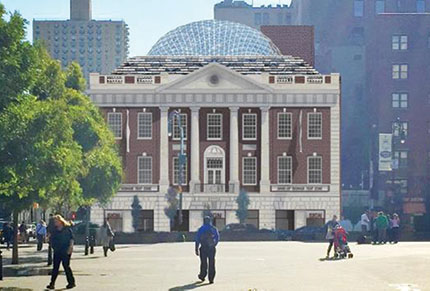 44 Union Square - New York, N.Y.
New York, NY RM Capital Management has arranged $57.5 million of first mortgage and mezzanine construction financing for the redevelopment of the Tammany Hall Building on behalf of Reading International, Inc. The construction financing will allow for the renovation and repurposing of the landmarked Tammany Hall building located at 44 Union Sq. into a six-story glass-domed destination retail and office building containing 73,322 rentable s/f, inclusive of BOMA adjustments and subject to lease negotiations and the final tenant mix. Upon completion, it is currently anticipated that the project will be comprised of three contiguous lower levels of retail and three floors of office space.
The property, the former headquarters of the Tammany Hall political organization, required a variance and Landmarks Commission approval to move forward with the development.
“The landmarked Tammany Hall property will be transformed through a gut renovation and the addition of a new distinctive domed glass roof. This property will anchor the northeast corner of Union Square, which has been demanding a destination property such as this. Reading’s redevelopment plan fits the bill perfectly,” RM Capital’s co-managing partner Marc Sznajderman said.
The $50 million senior construction financing was provided by Bank of the Ozarks and the $7.5 million mezzanine loan was provided by an affiliate of Fisher Brothers. “We are thrilled to be working with Bank of the Ozarks and Fisher Brothers on this exciting project. RM Capital expertly guided us through this complex financing,” said Margaret Cotter, executive vice president of real estate management and development – NYC for Reading International. The financing was placed by co-managing partners Marc Sznajderman and Romano Tio and vice president Bo Diamond of RM Capital.
“The complicated nature of the construction and the scarcity of development financing in general required a lending team that understood the value of the location and a structure that met the needs of the project and the borrower,” said Michael Buckley, managing principal of Edifice Real Estate Partners, the development manager for the project. “RM Capital worked closely with the lenders and Reading to ensure nothing was lost in the translation and managed the process throughout to a successful closing,” he said.
Tags:
Brokerage
MORE FROM Brokerage
Meridian Capital Group arranges 10-year retail lease for Mess at 236 West 10th St.
Manhattan, NY According to Meridian Capital Group, Jordan Langer, Noam Aziz and Carson Shahrabani of the firm’s retail leasing team have arranged a five-year lease at 236 West 10th St. in Greenwich Village


.jpg)

.gif)
Columns and Thought Leadership

Strategic pause - by Shallini Mehra and Chirag Doshi
Many investors are in a period of strategic pause as New York City’s mayoral race approaches. A major inflection point came with the Democratic primary victory of Zohran Mamdani, a staunch tenant advocate, with a progressive housing platform which supports rent freezes for rent

Behind the post: Why reels, stories, and shorts work for CRE (and how to use them) - by Kimberly Zar Bloorian
Let’s be real: if you’re still only posting photos of properties, you’re missing out. Reels, Stories, and Shorts are where attention lives, and in commercial real estate, attention is currency.
AI comes to public relations, but be cautious, experts say - by Harry Zlokower
Last month Bisnow scheduled the New York AI & Technology cocktail event on commercial real estate, moderated by Tal Kerret, president, Silverstein Properties, and including tech officers from Rudin Management, Silverstein Properties, structural engineering company Thornton Tomasetti and the founder of Overlay Capital Build,

Lasting effects of eminent domain on commercial development - by Sebastian Jablonski
The state has the authority to seize all or part of privately owned commercial real estate for public use by the power of eminent domain. Although the state is constitutionally required to provide just compensation to the property owner, it frequently fails to account
.gif)