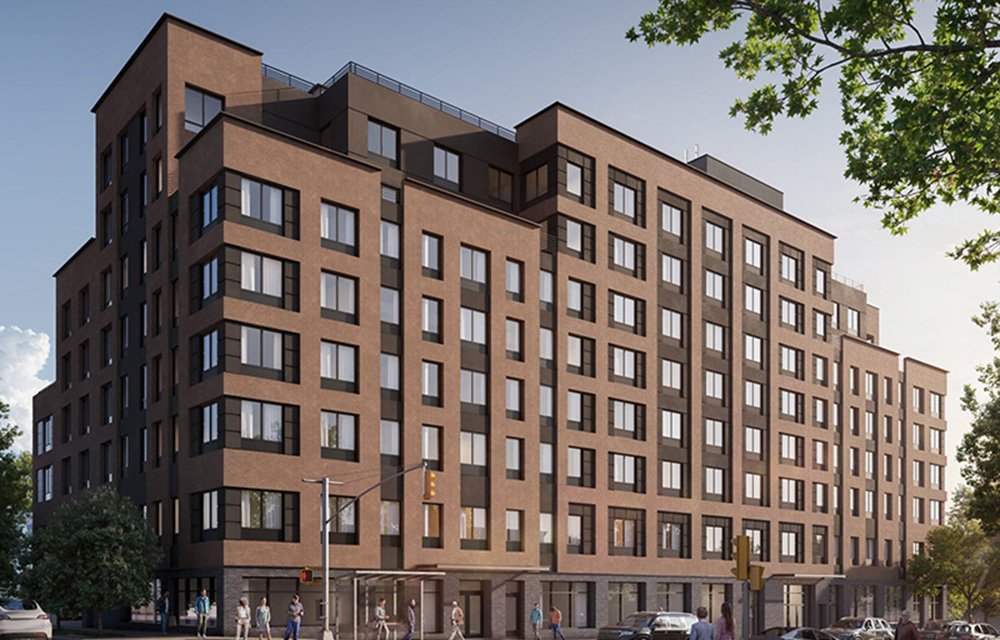




Manhattan, NY After eight years of planning, design and construction work, RKTB Architects has completed a new house of worship for Shaare Zedek, a Jewish congregation on the Upper West Side. Occupying the cellar, first and second floors of a new condominium tower erected on the site where Shaare Zedek’s original synagogue stood since 1923, the design represents a collaboration between RKTB’s design team and architect Lance Jay Brown, FAIA, in partnership with congregation president Michael Firestone and ODA Architecture, the firm responsible for the residential tower design.
Shaare Zedek leaders and congregants returned to meeting at 210 West 93rd St. beginning in the summer of 2024 after a number of years of meeting in temporary locations. As conceived by RKTB and Brown, the new 16,000 s/f synagogue combines innovation, sustainability, flexibility and accessibility, with homages to the architecture of the temple it replaces. Of note is the reuse of several large-format installations of stained glass, preserved prior to demolition in 2017, and elements that allow natural light to enter the sanctuary space and the social hall below.
The redevelopment of the site with a mixed-use multifamily residential tower is – along with sharing the new synagogue facilities with another congregation, Kehilat Hadar – part of a strategy to enhance both congregations while growing their membership.
“From our early conversations with Firestone’s team, we understood the goal for the new shul was to incorporate flexibility to facilitate use by both Shaare Zedek and their partner congregation Kehilat Hadar,” said Carmi Bee, FAIA, design principal with RKTB. “We collaborated with our friend and colleague Lance Jay Brown to envision a modern reimagining of the 1923 neoclassical structure and original sanctuary, aiming to honor the past history and legacy while creating a warm and welcoming atmosphere for community and inspiration.”
Shaare Zedek’s terms for the redevelopment ensured the congregation’s use of three floors of the new tower, two above grade and one below. To ensure best outcomes, Firestone led a design advisory committee composed of staff and congregants to work with RKTB and Brown on programming and design choices, as well as how to handle the question of the multiple large installations of priceless stained glass retrieved from the original temple prior to demolition.
“Designing a synagogue is more than shaping a space — it’s about honoring a living heritage,” said Albert Aronov, AIA, principal with RKTB and design team member. “As Jews, we want our buildings to reflect who we are, where we come from, and what we believe. Each feature is a bridge between generations, connecting the past to the present and grounding faith in form.”
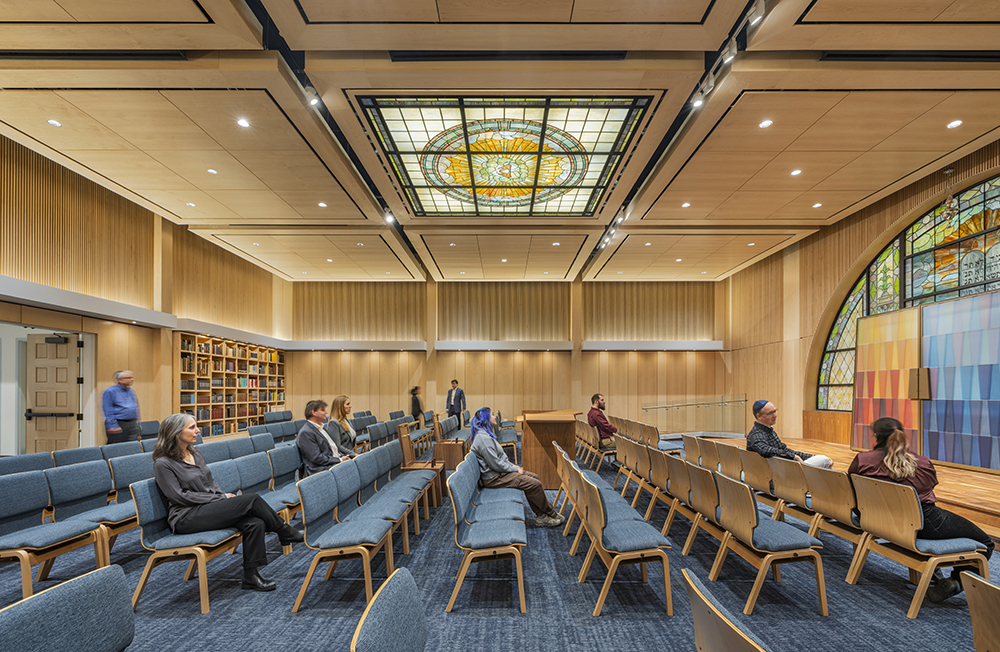
Ultimately the decision was made to integrate two of the most significant glass panels into the new sanctuary, preserving the rest in storage. Depicting Mount Sinai, the larger of these two – itself a multi-panel composition – retains its honored position behind the ark and facing the sanctuary seating as it did for nearly a century.
“Designing a place of worship, a profoundly spiritual place, is one of the greatest privileges an architect can have,” says Brown, an educator and author in addition to being an architect, as well as founder of Consortium for Sustainable Urbanization. “Doing so in Manhattan to serve a generation descended from immigrants who strived and succeeded in maintaining their culture in a new land only adds to the richness of the challenge.”
As an homage to the significant role in Jewish tradition of books as sources of inspiration, the architects integrated bookshelves across the entire rear wall of the space on either side of the entrance. Additionally, a nearby study room is also replete with bookshelves on every wall including surrounding a second ark, the door of which is composed of the stained glass from the original synagogue’s ark. In both this room and the sanctuary the millwork matches the large wood panels covering most of the sanctuary’s walls and ceilings. Above, more wood panels form a nine-square grid, recalling a similar gesture from the original synagogue ceiling and symbolizing balance and centeredness as represented by “sacred geometries,” according to RKTB’s Bee.
For the center square, the architects installed the other reutilized stained glass panel, itself a nine-square grid of smaller panels, reinforcing the symbolism. Illuminated from behind, the glass installation evokes a skylight effect, while wood grills composing the wall behind the ark allow natural daylight to filter inside. For a seamless aesthetic, air supply and return are located in the gaps between the ceiling panels. Combined with wall fins to break up and disperse ambient sound, the wood paneling also provides acoustical dampening to create a serene and reflective environment, while matching soffits along the walls contain LED cove lighting.
“Reintroducing these treasured glass panels is like transplanting a heart,” says Bee. “For the third-oldest Jewish congregation in the city, it’s very meaningful to maintain this connection to the past.”
Flexible and inspiring
Bee notes that RKTB has designed synagogues previously, including Beth Elohim in Park Slope, Brooklyn and both Village Temple and Park East in Manhattan, adding that all the firm’s work, including schools and multifamily residences, are designed invoke a connection to the spirit. This concept takes a heightened importance in a place of worship, he says, so even the street-facing façade had to speak to Shaare Zedek’s identity and represent it to the community. RKTB and Brown collaborated with ODA to create a two-story massing of textured limestone – the stone seems at first to be positioned randomly, but in fact reference the arrangement of stones in Jerusalem’s Wailing Wall.
Other gestures aimed at inspiring occupants include the coffered ceiling of the social hall under the sanctuary, which features a graphic design like a constellation that subtly evokes the Star of David, as well as a skylight intervention for some penetration of natural daylight.
Notably, design elements that support flexibility of use are found everywhere. The sanctuary features movable furnishings, including the bimah and the chairs utilized in place of fixed pews. The inclusion of the small chapel with its own ark allows for simultaneous services, while it also doubles as a study or meeting room. One of the five classrooms located on the second floor features a partition for added flexibility, as does the lower level social hall.
“Attending the first Bar Mitzvah in the new sanctuary was as moving as could be hoped for, a joyous and joyful celebration of life in a reconstituted home for the 21st Century,” says Brown.
Adds Bee, “We’re proud of the outcome, after a decade or more. Working alongside Lance and my RKTB colleagues – Albert Aronov and associate Nelya Sachakova – has been a pleasure, and the space will serve Shaare Zedek for many decades to come.”
.gif)
.jpg)


.gif)