



News:
Long Island
Posted: June 14, 2022
Mark Design Studios designs Nino’s Beach eatery
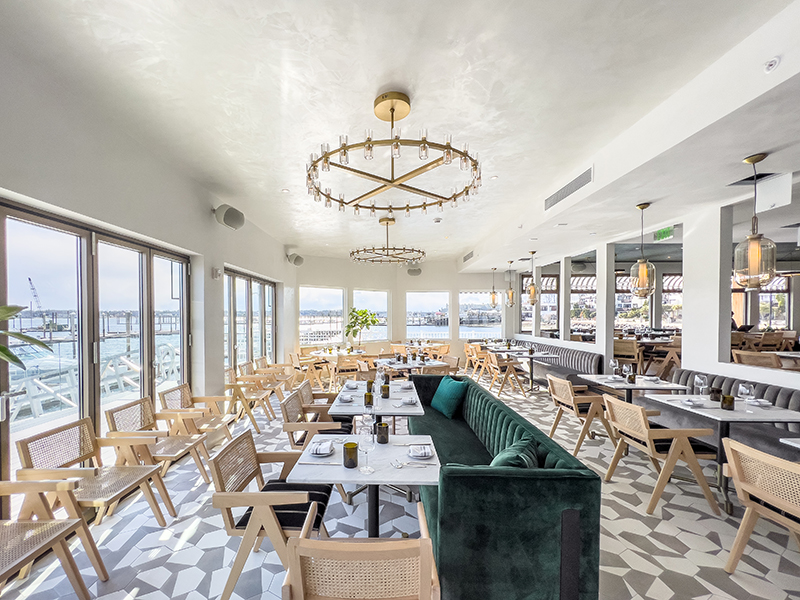 Port Washington, NY Mark Design Studios celebrated the opening of Nino’s Beach, a Mediterranean-style eatery on the North Shore of Long Island, for which it designed a “floating restaurant” situated over Manhasset Bay.
The renovated, 11,000 s/f restaurant, located at 43 Orchard Beach Blvd., was constructed on a system of existing timber piers and decking as a workaround to a geographically challenging site in the North Shore of Long Island.
The completed project cost $3 million.
“We achieved the essential objective of comfort and style by designing a flooring system using a structural insulation panels system with splines to attach each panel for greater comfort as well as stability and resistance to tidal movement,” said Michael Mark, AIA, principal of Mark Design Studios Architecture. “We needed to account for all the variables of a building above water, including humidity, high wind and tides. We and the client are thrilled with the outcome. You’d never know you are eating directly above water.”
Working closely with the general contractor Penta Restoration Corp., the floor panels were comprised of marine-grade plywood, polyisocyanurate insulation and a low-emitting composite wood substrate flooring for enhanced moisture resistance. This achieved a uniformly level floor while meeting energy code and providing a comfortable walking surface that could receive the designed floor finishes.
High performance windows and exterior doors with minimal extrusions meet the demands of the climate as well as maximize the views. Custom folding glass doors were utilized to open the space to the south deck on fair weather days to allow patrons to enjoy unobstructed spectacular sunset views over the famed Manhasset Bay.
To protect the drainage pipes below the deck from freezing, Mark Design Studios utilized electrical heat trace. Since the existing roof structure could not support the weight of the ventilation equipment required to provide energy-efficient heating, ventilation and air conditioning; a system of elevated steel dunnage above the walk-in boxes were designed to support the mechanical equipment as well as to keep it elevated well above the flood plain.
These systems work in unison to resolve the challenges of the location while preserving the pristine views to the surrounding waterways.
Tags:
Long Island
MORE FROM Long Island

Suffolk County IDA supports expansion of A&Z Pharmaceuticals
Hauppauge, NY The Suffolk County Industrial Development Agency (IDA) has granted preliminary approval of a financial incentive package that will assist a manufacturer in expanding its business by manufacturing more prescription (Rx) pharmaceuticals in addition to its existing over-the-counter





Quick Hits
.gif)
.jpg)
Columns and Thought Leadership

The evolving relationship of environmental consultants and the lending community - by Chuck Merritt
When Environmental Site Assessments (ESA) were first part of commercial real estate risk management, it was the lenders driving this requirement. When a borrower wanted a loan on a property, banks would utilize a list of “Approved Consultants” to order the report on both refinances and purchases.