



News:
Brokerage
Posted: August 29, 2023
Jack Resnick & Sons finalize two leases - 108,086 s/f at One Seaport Plaza
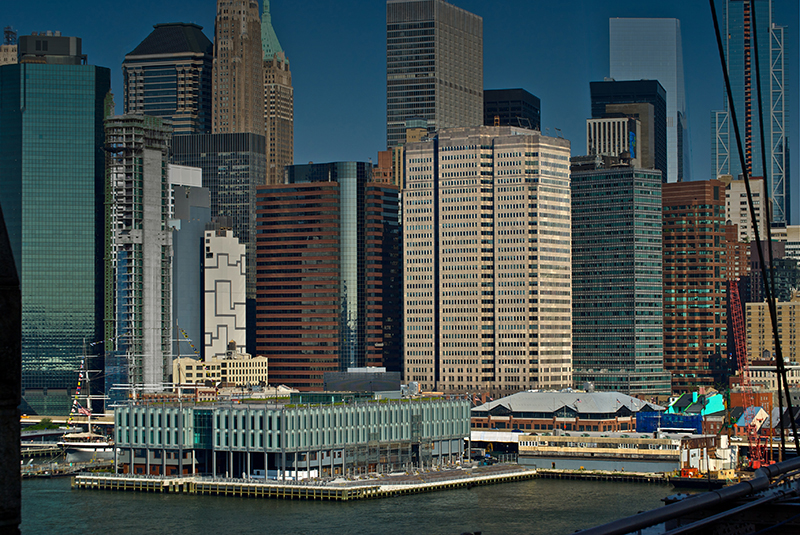
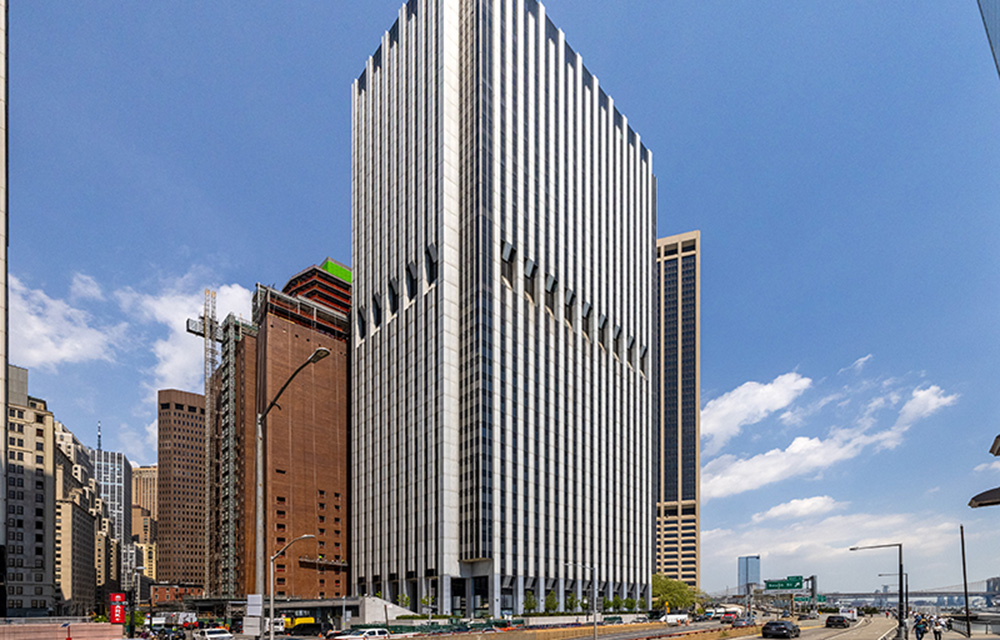
Manhattan, NY Jack Resnick & Sons has finalized two lease renewals totaling 108,086 s/f of office space with two social service organizations at One Seaport Plaza, its 1.1 million s/f property located downtown at 199 Water St.
The Legal Aid Society, which was founded in 1876 and has since grown into one of New York City’s most influential and effective social justice law firms and has been located at One Seaport Plaza for two decades, has renewed its lease on the entire 3rd and 6th floors totaling 72,091 s/f for five years.
Resnick also completed a 15-year lease renewal with the Center for Reproductive Rights. The global human rights organization of lawyers and advocates, which has been headquartered at One Seaport Plaza for the past 10 years, will continue to occupy 35,995 s/f of space across an entire floor at the tower.
Jack Resnick & Sons was represented in-house in both transactions by Adam Rappaport and Brett Greenberg. Craig Reicher and Christopher Mansfield of CBRE represented The Legal Aid Society. Daniel Horowitz, Jeffrey Peck, Ira Schuman and Stephan Steiner of Savills represented the Center for Reproductive Rights.
“We are pleased to extend our long-term relationship with The Legal Aid Society and the Center for Reproductive Rights,” said Jonathan Resnick, president of Jack Resnick & Sons. “These firms’ commitments are not only important for their missions, but for downtown Manhattan as well.”
“Ten years ago, when we first negotiated its lease, the Center for Reproductive Rights’ space was ahead of its time in terms of design and functionality for collaboration. It remains very effective in the post-Covid office environment,” said Daniel Horowitz, vice chairman at Savills.
Built in 1984 and located at the gateway to the Seaport District, One Seaport Plaza at 199 Water St. features a Swanke Hayden Connell-designed lobby accented by three paintings from the artist Frank Stella. The building also incorporates glass security turnstiles, a destination-based elevator system, a full-service messenger center, an executive in-building parking garage and tenant-dedicated bike and locker rooms.
The property is LEED certified from the U.S. Green Building Council (USGBC), WELL Health Safety rated, Wired Certified Platinum for excellence in internet connectivity and has also earned the EPA’s Energy Star certification. Other major tenants at 199 Water St. include Allied World Insurance, Cantor Fitzgerald, Howard Hughes Corporation and Stripe.
Tags:
Brokerage
MORE FROM Brokerage
Meridian Capital Group arranges 10-year retail lease for Mess at 236 West 10th St.
Manhattan, NY According to Meridian Capital Group, Jordan Langer, Noam Aziz and Carson Shahrabani of the firm’s retail leasing team have arranged a five-year lease at 236 West 10th St. in Greenwich Village


.jpg)

Quick Hits
.gif)
Columns and Thought Leadership

Behind the post: Why reels, stories, and shorts work for CRE (and how to use them) - by Kimberly Zar Bloorian
Let’s be real: if you’re still only posting photos of properties, you’re missing out. Reels, Stories, and Shorts are where attention lives, and in commercial real estate, attention is currency.

Strategic pause - by Shallini Mehra and Chirag Doshi
Many investors are in a period of strategic pause as New York City’s mayoral race approaches. A major inflection point came with the Democratic primary victory of Zohran Mamdani, a staunch tenant advocate, with a progressive housing platform which supports rent freezes for rent
AI comes to public relations, but be cautious, experts say - by Harry Zlokower
Last month Bisnow scheduled the New York AI & Technology cocktail event on commercial real estate, moderated by Tal Kerret, president, Silverstein Properties, and including tech officers from Rudin Management, Silverstein Properties, structural engineering company Thornton Tomasetti and the founder of Overlay Capital Build,

Lasting effects of eminent domain on commercial development - by Sebastian Jablonski
The state has the authority to seize all or part of privately owned commercial real estate for public use by the power of eminent domain. Although the state is constitutionally required to provide just compensation to the property owner, it frequently fails to account
.gif)