




This year marks the start of a new five-year filing cycle for New York City’s Facade Inspection and Safety Program (FISP). Fortunately, Cycle 10 presents few new hurdles, and even offers relief to owners who may have fallen behind.
New York’s facade initiative is one of the oldest and most robust in the nation. Launched with Local Law 10 of 1980, the rule was updated in 1998 with Local Law 11, a moniker for the program that persists today. Under 1 RCNY §103-04, owners of buildings over six stories are required to file a Critical Examination Report evaluating the condition of facades and appurtenances with the New York City Department of Buildings (DOB) every five years. Reports are due within two-year sub-cycles based on the last digit of the building’s block number.
Each cycle, a Qualified Exterior Wall Inspector (QEWI) must oversee the critical examination and determine whether facade assemblies are Safe, Unsafe, or Safe with a Repair and Maintenance Program (SWARMP). A condition that requires repair or maintenance within the next five years is considered SWARMP, unless it needs remediation within a year, in which case it is Unsafe. Note that the same condition at the same location cannot be classified as SWARMP in consecutive filing cycles. If unresolved, it becomes Unsafe.
The QEWI must alert the owner and the DOB of Unsafe conditions immediately, along with recommended measures to protect public safety. The owner must promptly implement these precautions, with public protection remaining in place until the condition is resolved and an amended report is filed and accepted. For SWARMP conditions, the QEWI is tasked with determining the appropriate timeframe for repairs.
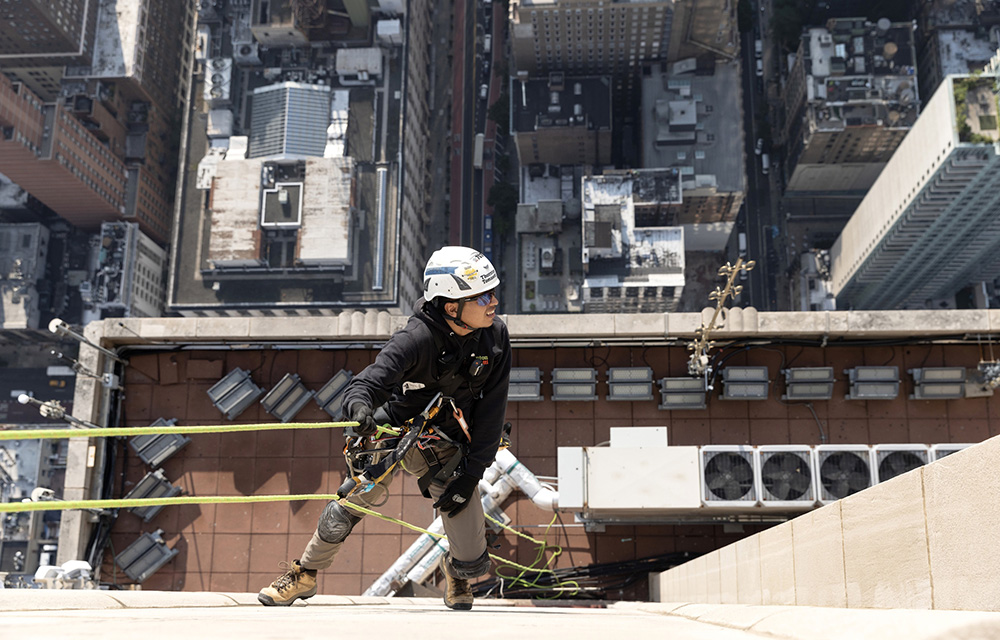
Since Cycle 9, the Critical Examination must include close-up inspections at least every 60 ft. along façades that front a public right-of-way, using scaffolding or other observation platform. It’s up to the QEWI to determine which areas pose the greatest potential hazard and to perform the physical examinations there. Also starting in Cycle 9, probes are required for cavity wall construction in at least every odd-numbered cycle. That means owners who underwent the disruption and expense of probes in the last cycle can likely skip it this time, unless the QEWI observes new or worsening conditions that warrant exploratory openings.
Within 60 days of the Critical Examination, the QEWI files a report categorizing the building as Safe, Unsafe, or SWARMP. Unsafe conditions must be corrected within 90 days of filing. It’s possible to request an extension, but it requires documentation and must be approved by the DOB.
Owners who are behind on FISP filing have an opportunity to break the cycle of accumulating civil penalties through a new program that allows for early filing. Rather than wait for their designated sub-cycle while facing years of compounding penalties, owners who failed to file a Cycle 9 report can apply to file early in Cycle 10. Once a Sub-Cycle Override is approved, the owner of a building with “No Report Filed (NRF)” status in Cycle 9 can return to full compliance by paying all existing civil penalties and filing a report in Sub-Cycle 10A.
In 2024, the DOB introduced a requirement for Annual Parapet Observation, which applies to all buildings in the city. Bundling parapet observation with the FISP Critical Examination saves the expense of duplicate efforts. Provided that the FISP report includes all information needed to satisfy Annual Parapet Observation requirements, no separate parapet report is necessary. Bear in mind that Parapet Observation is completed annually and so requires a separate report in years when a FISP report isn’t filed.
Penalties jumped substantially in Cycle 9, and these steep fines remain in place for Cycle 10. Compared with a penalty of $1,000 per month for late filing, compounded by an extra $5,000 per year for failure to file, the $425 fee for filing a FISP report is relatively modest. Failing to correct SWARMP conditions incurs a civil penalty of $2,000, whereas Unsafe conditions left unresolved yield a penalty of $1,000 per month, plus additional monthly charges per linear foot of sidewalk shed, which grow exponentially the longer the sheds are in place.
To stay in compliance, here are five steps to take now: (1) determine the Cycle 10 filing window, (2) retain a DOB-certified QEWI, (3) apply to file early (if no report was filed in Cycle 9), (4) address outstanding Unsafe and SWARMP conditions, and (5) schedule the Critical Examination far ahead to arrange for lifts, scaffolding, contractors, and associated permits.
Property owners who filed during Cycle 9 will find few surprises with Cycle 10. Parapet Observation presents new requirements, but owners also benefit from new opportunities for relief from accumulating noncompliance penalties. An experienced QEWI can offer a customized FISP strategy that protects public safety and the long-term integrity of the building enclosure.
Juan Kuriyama, AIA, QEWI, and Alison Hoffmann, AIA, Hoffmann Architects + Engineers, Manhattan, N.Y.
.gif)
.jpg)


.gif)