



News:
Owners Developers & Managers
Posted: June 23, 2020
What the new bird friendly Local Law 15 means to you - by Heath Waldorf

Bird safe buildings have been a growing part of the NYC skyline for years. Some examples of New York City architecture that incorporate the principles of bird-friendly design include The New York Times Building, Interactive Corp.’s headquarters, Cooper Union, and the renovated Jacob Javits Convention Center which gave up its crown as the biggest bird killer in New York City by reducing collisions by 90% through design measures.
What was once the vision of a passionate few, that buildings should be made bird friendly, has become law for the many. In January 2020, based on the support of and the insights provided by the New York City Audubon Society, Local Law 15/20 was passed in New York City making all new construction and renovation projects (where glazing is to be replaced) required to use bird friendly materials as described below for projects filed with the Department of Buildings after January 10th, 2021.
Enticements or requirements for bird safe buildings like those that have been enacted in New York are not new. In 2009, the USGBC’s LEED program introduced a pilot credit for bird collision deterrence. In 2013, San Francisco launched its program. Add to that, suburban Chicago areas, Toronto, and the Federal Government have all put forth their own standards to which architects and building owners must comply. The trend is set to continue with new legislation pending in Chicago proper and the District of Columbia region.
What does compliance look like?
Among the various bird-safe initiatives, the Code written for New York City is both the strictest of standards (coverage areas, building/project types, no-exemption relative to geography) and also the simplest to apply in a broad sense. There are no required calculations of façade materials used or creation of effectiveness monitoring plans as is the case in the LEED credit, no issues with reflectivity of glass specifically (Toronto), no determining proximity to urban wildlife areas (San Francisco), and no provisions requiring particular lighting design and controls (all of the previous).
The NYC code requires application of the American Bird Conservancy’s Material Threat Factor Rating (MTFR or TF) system to the exterior wall envelope and other identified strategic locations. In layman’s terms, the lower the TF, the more visible the material is to birds. The code requires that bird-friendly materials be used, those with a TF of less than 25 as the firm threshold, in the following identified locations:
- The Exterior Wall Envelope from grade up to 75 ft. Ironically, 75 ft. is the definition of a “skyscraper” according to the building code, though the bird-friendly code is not limited in applicability to skyscrapers. Most bird collisions happen at lower sections of a building and therefore this is the most critical area to be protected.
- So called “Bird Hazard Installations” such as awnings, railings, or glass acoustic barriers must also be constructed of bird friendly materials.
- Any “Fly Through Conditions” where parallel or perpendicular panes of glass are installed such that a bird thinks they can fly straight through should be avoided or made of bird friendly materials.
- Those locations with adjacency to green roofs, 12 ft. up the exterior envelope regardless of the height of the roof must also be bird friendly in design.
Exceptions are made for circumstances where ground floor transparency or flood resistant glazing is required are required by a Zoning Resolution.
Applying the rules to design thinking
In truth, many bird-friendly design strategies overlap with elements of sustainability; managing lighting or glare and measures taken to ensure a building is managing heat gain effectively. Using more solid panels (opaque) rather than glass has an impact on all of the above. However, unlike the LEED credit scenario where the entire façade is given a formulaic calculation and it is possible to use glass that does not individually meet the 25TF threshold because the judgement of bird-safe is based on a blended average of materials used. With this new code, however, even with a reduced amount of glass, there is still a requirement that what glass is installed in NYC must be below that 25 TF.
In order to make glass bird-safe, two strategies are used:
- Add visual markers to surface 1 or surface 2 based on a 2”x4” spacing rule where etchings or frits in particular patterns/colorings/surface locations are incorporated. This can be done with lines of certain thickness, dots of a certain size, etc.
- Integration of a UV film, strategically placed closer to the external glass surfaces than any low-e coating. There are exceptions where this can be altered, but each attempt to deviate from a previously tested configuration will require new testing or judgement by the American Bird Conservancy.
The American Bird Conservancy maintains a list of previously approved products from leading manufacturers. Alternate suppliers or custom configurations / patterns can be used but must be approved in advance by the ABC.
The ordinance does not have much of an impact on design if you are simply willing to absorb the added cost of using specially treated glass in lieu of what you otherwise would have for your project. But given the potential for cost increases of UV films interlaid in a glazing system or risk of aesthetic degradation of using glass with visual markers such as frits or etching, it is wise to be considerate of the bird friendly requirement earlier in the design process when creativity is more of an option.
Heath Waldorf is the principal consultant at Bird Control Advisory, New York, N.Y.
MORE FROM Owners Developers & Managers
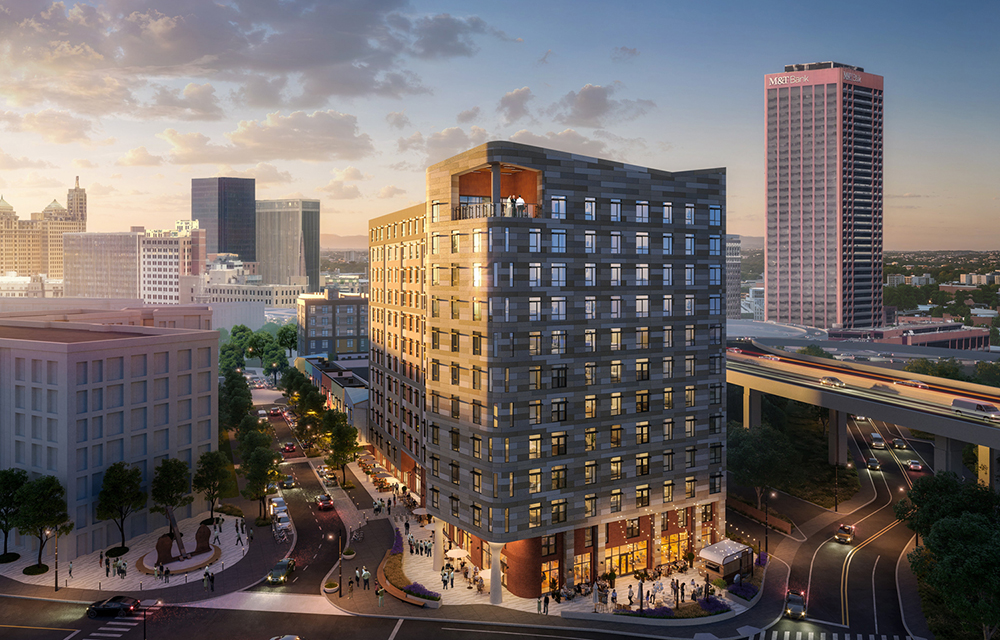
Habitat, Duvernay + Brooks and Buffalo Municipal Housing close on 254-unit first phase redev. of Marine Drive Apts.
Buffalo, NY The Habitat Company has closed on Marine Drive Apartments, officially setting in motion the redevelopment of the historic waterfront site. The project, undertaken by Habitat in partnership with Duvernay +


.gif)



.jpg)
Columns and Thought Leadership

Strategies for turning around COVID-distressed properties - by Carmelo Milio
Due to the ongoing pandemic, many landlords are faced with an increasing number of distressed properties. The dramatic increase in unemployment and reduction in income for so many has led to a mass exodus out of Manhattan, an increase in the number of empty rental units

The CRE content gap: Why owners and brokers need better digital narratives in 2026 - by Kimberly Zar Bloorian
As we head into 2026, one thing is clear: deals aren’t won by who has the best asset; they’re won by who presents it best. Yet many owners, operators, and brokers are entering the new year with outdated photos, inconsistent branding, and limited digital presence. This
.gif)