



News:
Spotlight Content
Posted: July 18, 2017
Railroad revitalization leads to new economic opportunities in Chenango County
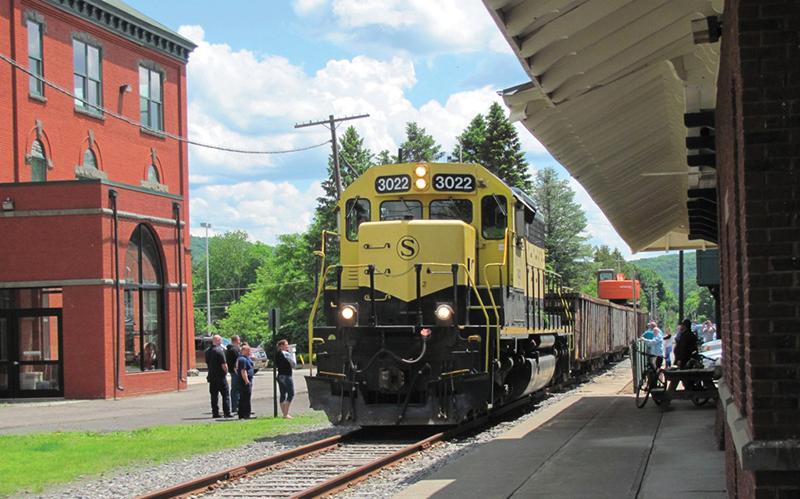
Norwich, NY Chenango County is poised for a resurgence of activity on one of the county’s two rail lines, as their railroad revitalization project ends. After serious flooding in June 2006 the line was faced with, a number of washouts and the cost of repairs rendered it inert. Commerce Chenango and the County of Chenango Industrial Development Agency (CCIDA) didn’t take long to begin planning for its’ return. Still, the County endured over ten years without service on the Utica Main Line, cutting off businesses from a major logistical option and hampering economic development efforts.
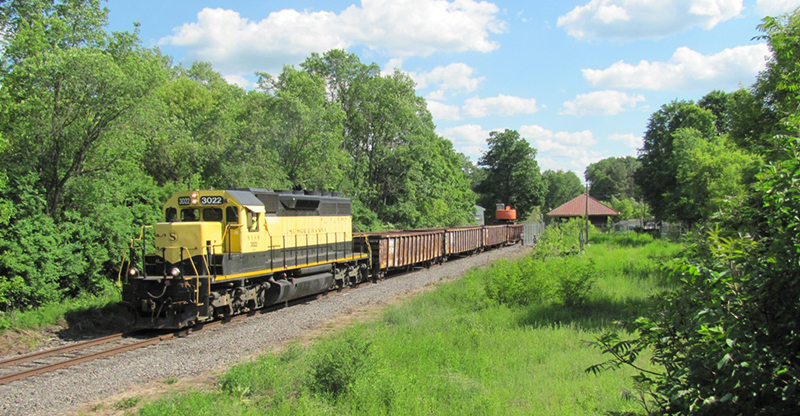 However, this May the first train to traverse the county since 2006 sounded its’ horn, ushering in hopes of new opportunity and economic revitalization. Chenango County has a number of available properties that could seize on these re-opened possibilities. Even properties that are not rail-side, such as on East Main St., stand to benefit as the local economy improves through rail access. A rising tide lifts all boats, as the saying goes.
A couple of available properties in Chenango with rail access include:
• Cherry St.: Newly renovated facility with 22,000 s/f manufacturing space and 3,000 s/f office on 30 acres; and
• 57-59 Borden Ave.: This rail-side property is 139,780 s/f, has 13 loading docks, 21 foot ceilings, extensive parking, city water and sewer, and four current long-term tenants.
The New York Susquehanna & Western line runs from the southwest to northeast corners of the county, connecting Binghamton and Utica. Chenango County also continues to receive rail service in Bainbridge and Afton through Norfolk Southern.
Historic Properties
Chenango County has a number of historic properties that may be eligible for historic preservation tax credits in addition to other development incentives. Those interested in historic restoration can find some beautiful properties with fascinating backstories. Two examples are:
• 20 American Ave.: Located downtown, this building is the former manufacturing facility for Norwich Pharmacals’ Unguentine Ointment. It is a heated four-story masonry warehouse that has two covered loading docks with 16’ clearance & 12’ ceilings providing a great opportunity for mixed-use development; and
• 125-127 East Main St.: While not rail adjacent, this property is, a former school building that is 13,272 s/f, three stories, has parking, wheel-chair access, and a number of large rooms suited to many potential uses.
Economic Development
The CCIDA and Development Chenango Corp. are leading economic development efforts as the railroad reemerges on the scene. The CCIDA provides several types of incentives to manufacturers whose expansion or development lead to job creation in the county. Manufacturers considering locating in the county are encouraged to contact the CCIDA to learn about incentives like PILOT programs, sales and use tax exemptions, mortgage recording tax exemptions, and tax-exempt bonds. Development Chenango Corp., another economic development entity for the region, offers low interest loans and grant application assistance to those looking to locate in the county. Small and large business owners should be aware of these programs, as the return of rail service promises to tip the scales on businesses’ location decision-making.
Visit www.chenangony.org for more information on Commerce Chenango services and programs.
Tags:
Spotlight Content
MORE FROM Spotlight Content

Over half of Long Island towns vote to exceed the tax cap - Here’s how owners can respond - by Brad and Sean Cronin
When New York permanently adopted the 2% property tax cap more than a decade ago, many owners hoped it would finally end the relentless climb in tax bills. But in the last couple of years, that “cap” has started to look more like a speed bump. Property owners are seeing taxes increase even when an


.png)

Quick Hits
.gif)
.jpg)
Columns and Thought Leadership

Oldies but goodies: The value of long-term ownership in rent-stabilized assets - by Shallini Mehra
Active investors seeking rent-stabilized properties often gravitate toward buildings that have been held under long-term ownership — and for good reasons. These properties tend to be well-maintained, both physically and operationally, offering a level of stability

The strategy of co-op busting in commercial real estate - by Robert Khodadadian
In New York City’s competitive real estate market, particularly in prime neighborhoods like Midtown Manhattan, investors are constantly seeking new ways to unlock property value. One such strategy — often overlooked but

How much power does the NYC mayor really have over real estate policy? - by Ron Cohen
The mayor of New York City holds significant influence over real estate policy — but not absolute legislative power. Here’s how it breaks down:
Formal Legislative Role
• Limited direct lawmaking power: The NYC Council is the primary

Properly serving a lien law Section 59 Demand - by Bret McCabe
Many attorneys operating within the construction space are familiar with the provisions of New York Lien Law, which allow for the discharge of a Mechanic’s Lien in the event the lienor does not commence an action to enforce following the service of a “Section 59 Demand”.
.gif)