
Skanska concludes renovation of <br>HSS Sports Medicine Institute West Side
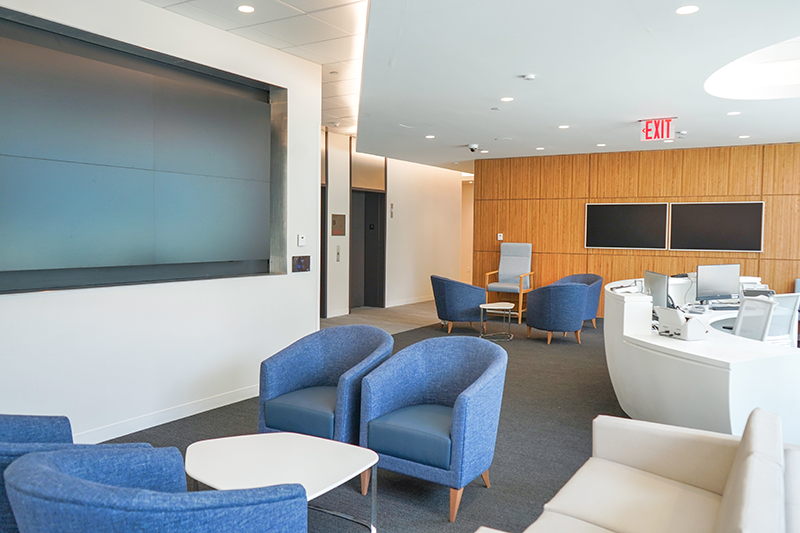
Manhattan, NY Skanska, a leading global construction and development firm, today announced the completion of the $8 million renovation of Hospital for Special Surgery (HSS) Sports Medicine Institute West Side.
Skanska worked with Batska Consulting Group, the owner’s project management representative who coordinated with all project stakeholders to ensure a successful completion. The project involved a comprehensive, phased renovation spanning multiple areas of the facility, with a primary focus on transforming the fourth floor into a fully functional outpatient clinic. This 12,000 s/f renovation introduced 15 new exam rooms, MD offices, and a storage area, while also upgrading the building’s mechanical, electrical, and plumbing (MEP) distribution and mechanical systems to accommodate the new operations. Additional improvements included the integration of a new X-ray room, an ultrasound-guided injection exam room, and an Article 28-compliant renovation of cellar-level space.
Construction on the 66,000 s/f project began in August of 2024 and the team achieved substantial completion in May 2025.
“We are proud to collaborate with HSS and to be celebrating the successful expansion of this cutting-edge, high-performance healthcare facility that treats more than 95,000 patients per year,” said Sean Szatkowski, executive vice president, general manager, Skanska USA Building.
“Situated within a fully operational residential building, the project required extensive collaboration with HSS operations, the building’s landlord, and neighboring tenants to ensure minimal disruption to patients, healthcare staff, and residents.”
“The completion of this expansion marks an exciting new chapter in our commitment to delivering exceptional outpatient care,” said Melissa Kiefer, vice president, facilities development and regulatory affairs at HSS. “By broadening our services and enhancing the patient experience, we’re better equipped than ever to meet the evolving needs of the communities we serve. We appreciate Skanska’s collaboration in helping us reach this milestone.”
Another integral and unique component to navigate throughout this project was the precision-driven approach to addressing floor flatness, an often overlooked but critical factor in healthcare environments where even minor variations can impact equipment functionality, making quality assurance and quality control (QA/QC) efforts essential to maintaining performance and safety standards. The team utilized advanced point cloud technology to digitally map the space and to evaluate floor flatness to be within two millimeters. These scans generated detailed heat maps of floor depressions, were overlaid with Building Information Modeling (BIM) models for QA/QC checks, and guided floor leveling strategies were implemented to ensure compliance with equipment specs. This process also helped coordinate ceiling heights and above-ceiling utilities.