
Richter+Ratner completes 45,000 s/f interior fit-out for Xavier High School; Architect was Beyer Blinder Belle; Structural Engineer was McLaren
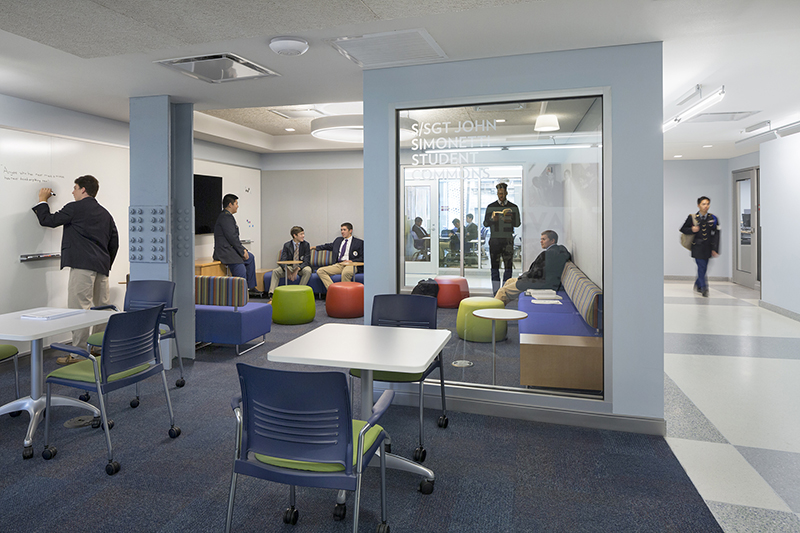 The new Hall houses multiple informal meeting and social areas, including the Staff Sgt. John Simonetti Student Commons on the fifth floor, named after the U.S. Army Ranger killed in action in France in 1944. Simonetti was an uncle of a Xavier graduate John Salerno. Photo credit: Ari Burling.
Manhattan, NY Construction manager Richter+Ratner (R+R) and architect Beyer Blinder Belle have completed the interior fit-out of Xavier High School’s 45,000 s/f Fernandez-Duminuco Hall. The project is located on six floors and the cellar level of a new 25-story, mixed-use building at 35 West 15th St. Xavier is a Jesuit college preparatory school for young men founded in 1847 in the Chelsea neighborhood. The school’s campus includes six buildings located alongside the Church of Saint Francis Xavier.
“Fernandez-Duminuco Hall is Xavier’s first campus expansion in more than 90 years. It has provided our community of nearly 1,100 students and 84 full-time faculty members with state-of-the-art classrooms, large common spaces, and a special emphasis on robotics and music education,” said Xavier president Jack Raslowsky, a parent of a 2016 graduate.
“The nine-month-long project called for the construction of a STEAM classroom, ultramodern music facilities, a recording studio, a student project space, and a flexible multi-use area that hosts theater productions and major assemblies. The new facilities are next door to Xavier’s existing buildings and are connected to one of them on floors two, three, and five,” said R+R CEO & president Marc Heiman.
Fernandez-Duminuco Hall is located within a larger 170,000 s/f, 330-ft. tall residential condominium tower named 35XV, which was designed by FXFOWLE. The developer, Alchemy Properties, obtained the air rights for the new building from Xavier High School in exchange for locating the Hall inside the new development.
In addition to R+R, Beyer Blinder Belle, and McLaren Engineering, which served as structural engineer for the building connections, the project team included owner’s representative Sterling Project Development; structural engineer for the tower Nash Engineering; mechanical, electrical, and plumbing (MEP) engineer AKF Group LLC; and acoustical consultant Acoustic Distinction.
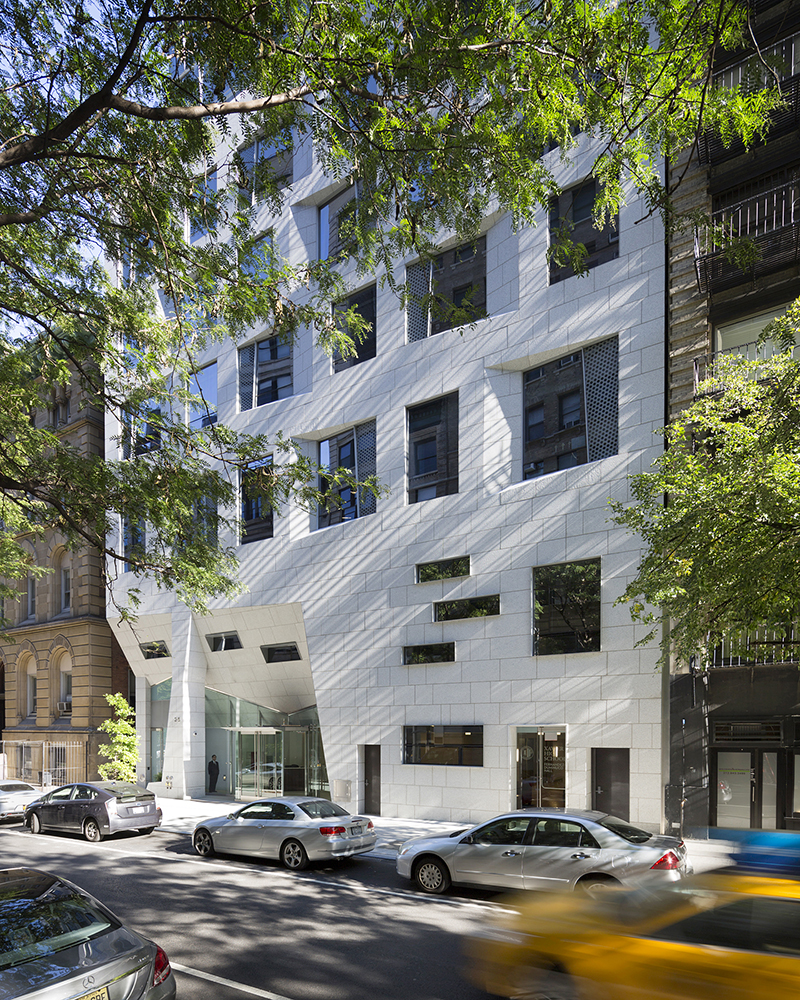 Xavier High School’s new 45,000 s/f Fernandez-Duminuco Hall is located on six floors and the cellar level of a new 25-story, mixed-use building at 35 West 15th St. Photo by Ari Burling.
“This project was part of a master plan focused on clarifying the entrance and circulation among the buildings, and improving the student experience through state-of-the-art facilities, a variety of learning environments and gathering areas, and a graphic design program to enliven the common spaces with depictions of contemporary student life and the history of Xavier,” said Beyer Blinder Belle associate Tom Lindberg, AIA, LEED AP.
The 55-condominium residential portion of the building begins almost 100 ft. above ground level. The school section is accessible through a dedicated, separate entrance. There is a separate glass-clad entrance for the condominium residents at 35 West 15th St. The base building is clad in stone on the first six stories to indicate the location of the Xavier School and reflect the architecture of the neighboring buildings. Glass curtain wall was installed on floors seven to 25.
R+R executive vice president David Brown said, “The project team faced numerous logistical and technical challenges related to the age of the original school buildings and the work taking place within a larger structure that was still under construction.” There was a several-month overlap with the base building construction, so the R+R team had to coordinate site logistics – access, deliveries, debris pickup, and vertical transportation – with other building crews. R+R also had to replace a temporary sprinkler loop and add in all ductwork and electrical work to match the interior layout of the new school facilities.
Constructing connections between the buildings was the most challenging part of the project. “The existing Xavier High School building, to which the new Hall is connected, is over 100 years old and there were no plans or records for the original structure,” said Kristin DiStefano, P.E., LEED AP, R+R’s project manager. “When we took the protection off of the walls of the old building, all we saw was brick. We had no idea how thick the walls were or where we would wind up when drilling through. In addition, in the areas of the wall where we had to cut through, there were previously existing arches. We weren’t sure whether the arches were there for structural or ornamental purposes, or whether windows had been bricked up at some point. Upon inspection and consultation with a structural engineer McLaren Engineering, we opted for installing steel-angle lintels within seven ft. wide openings, where the connections between the buildings would be built.”
The additional technical challenge was that the elevations of floors in the two buildings were slightly different. On two of the floors, the existing building was lower then the new building, and on the third floor it was higher.
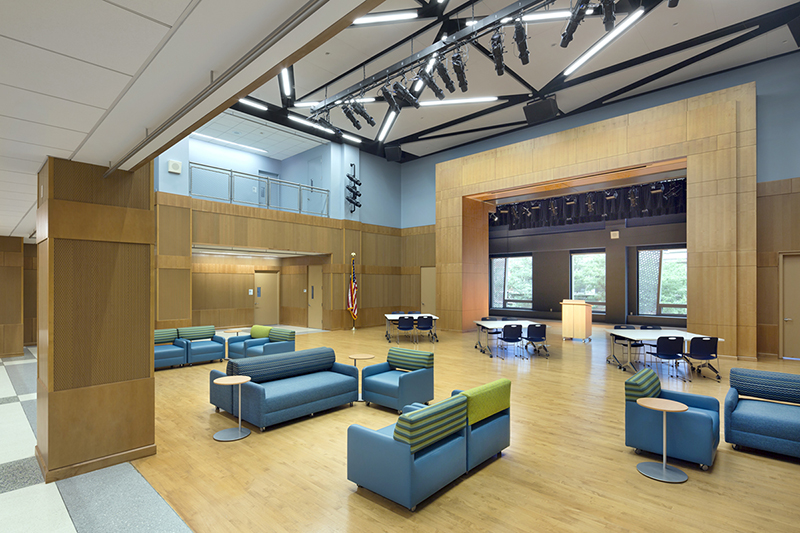 The 3,000 s/f, double-height auditorium on the third floor serves as a highly flexible, multipurpose performance and event space. It is equipped with theatrical lights, speakers, curtains, and rigging. Photo credit: Ari Burling.
Once the openings were prepared and structurally secured, R+R built connectors that bridge the two school buildings. The connectors feature steel steps that not only link the structures but also address differences between floor elevations. Weatherproof expansion joints go all around the walls and ceilings of the connectors. The opening on the fifth floor of the old building is equipped with additional steel bracing that reinforces the wall that was already bearing another structural steel element discovered during demolition. As a result, the corridor on the fifth floor is wider in the original building.
The first floor houses a 300-square foot conference room and a 500-square foot lobby meeting space. One wall is fitted with a large white board. The flooring is a rubber tile by Armstrong that is made to look like wood. The ceiling is an acoustical grid ceiling. This floor also houses bathrooms and a UPS generator room.
The second floor features a music suite that includes four 100-square foot practice and live rooms, a 250-square foot control room with recording and mixing capabilities, a 320-square foot ensemble room, and one large music room of 1,300 square feet. Supporting the school’s popular musical education program, operators in the control room can listen to and record performances in the music rooms, talk to students and teachers in other studios, and broadcast performances between the rooms.
The soundproof ceilings, walls, floors, windows, and doors acoustically separate one room from the next. To ensure proper sound isolation between spaces, R+R created a “floating” floor slab raised above the building’s concrete base floor on springs. The crews installed the springs, laid down a sheet of plastic, and then poured the concrete around the springs. Once the concrete cured, the contractor jacked the springs, which raised the newly poured slab, so that the new concrete floor floats two inches above the base slab. The springs are on a grid and are approximately four feet apart from each other. This flooring system, developed by Vibration Products, significantly reduces the transmission of vibrations into the building’s structure and other spaces.
The acoustic ceiling, too, uses springs. In this instance, it hangs off of isolation springs that absorb sound. It is a double-layer ceiling of sheet rock and a grid made of uni-strut. The windows, without mullions, are two big sheets of glass with air space in between them. Finally, acoustic clouds are affixed to the ceilings and fabric-wrapped acoustic panels are on all walls.
The basement features mechanical spaces, the elevator machine room, and electrical closets.
Floors Three Through Six
A 3,000 s/f, double-height auditorium occupies the third floor. Addressing the diverse needs of an urban school with limited available real estate, Beyer Blinder Belle designed it as a highly flexible, multipurpose performance and event space. For example, the auditorium has a big proscenium, but no permanent stage – the school brings in a demountable stage when needed. This allows for a variety of events to take place in this space, some of which would be obstructed by a built-in stage. Similarly, chair seating is brought in only when needed.
The auditorium is equipped with theatrical lights, speakers, curtains, and rigging. The curtains are custom-made and installed on rotating tracks. One row of theatrical lights by Barbizon Lighting Company is at the front of the house, with two rows in the back of the house. Around the stage is a large, 21-foot folding door that can cut the space in two. The door has wood finish on one side and blackout on the other. Fabric acoustic clouds are installed throughout. Custom perforated millwork acoustic panels are in the double-height space. There is a wood floor in the stage area and terrazzo elsewhere. Control room is located in the back of the auditorium. This floor also has a classroom, a pantry, and a corridor with a stainless-steel handrail.
The fourth floor is a mezzanine level wrapped around the double-height auditorium. It has one classroom stacked atop the third-floor classroom as well as two offices.
The fifth and sixth floors are education spaces. The fifth floor has two 700-square foot classrooms, a 1,300-square foot Science, Technology, Engineering, ART and Math (STEAM) classroom, a 500-square foot student project room/lounge, and an office. The STEAM classroom features a robotics workshop, tunable lighting, video production equipment, and 3D printers, as well as ergonomically adjustable furniture. In the lounge area there are monitors, collaborative furniture, and a plethora of outlets for plugging in laptops and other electronics.
This floor has two exposed columns with intumescent paint on them, one in the corridor and the other between the corridor and lounge. The corridors’ floors are terrazzo, while the classrooms feature Forbo sheet vinyl, and the lounge floor is finished in carpet tile. A Star Silent acoustic plaster ceiling was installed in the corridor and a sound mitigation ceiling panel system by Tectum was put in the lounge.
The sixth floor houses several classrooms as well. There are three 700 s/f standard classrooms and a super classroom at 900 square feet. Two faculty offices are on this floor, as well as a faculty office/lounge/conference room for meetings.