



News:
Owners Developers & Managers
Posted: October 11, 2022
Executive of the Month: Amanda Kaminsky is helping to secure Lendlease’s leadership in sustainable and healthy construction
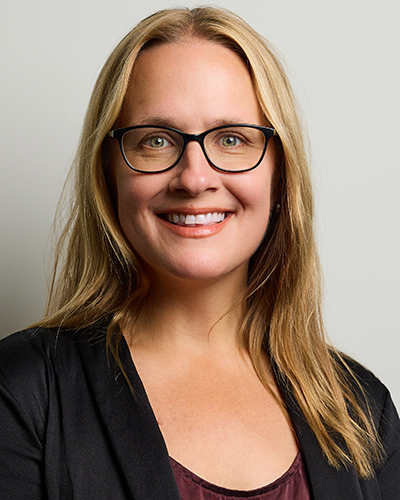
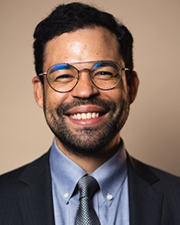
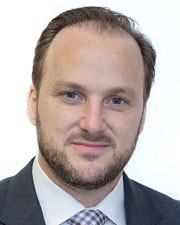
New York, NY The New York Real Estate Journal (NYREJ) sat down for a question-and-answer session with Amanda Kaminsky, director, sustainable construction – Americas at global real estate firm Lendlease and this month’s Design/Build Executive of the Month.
NYREJ: What inspired your entry into the construction industry?
I was educated as an architect. One day, early in my tenure with a small architecture and development studio downtown, I was tasked with visiting one of our mixed-use geothermal townhouse sites in lower Manhattan. Though I had worked on plenty of Habitat for Humanity builds throughout college, I was nervous about going out into the field to tell the contractors how to construct what I had drawn. I confessed to the crew that, while I helped to design this structure, I couldn’t tell them exactly how to build it. Well, they got a laugh out of that and were grateful, telling me this was the first time an architect had admitted they don’t know how to do their job as a contractor! Over a short time, job site visits became the highlight of each workday, as I became comfortable asking a lot of questions and learning how the building and its systems actually come together. I gained a lot of practical construction knowledge on that job, especially around geothermal, as we installed a 1,200-foot-deep vertical closed loop geothermal well system with efficient radiant heating and cooling. This all taught me early in my career to be humble in admitting what I don’t know, ask good questions, and listen carefully to colleagues with experience. It also made me a much better architect, but I had now become smitten enough with the construction and development side of the business to focus my career there.
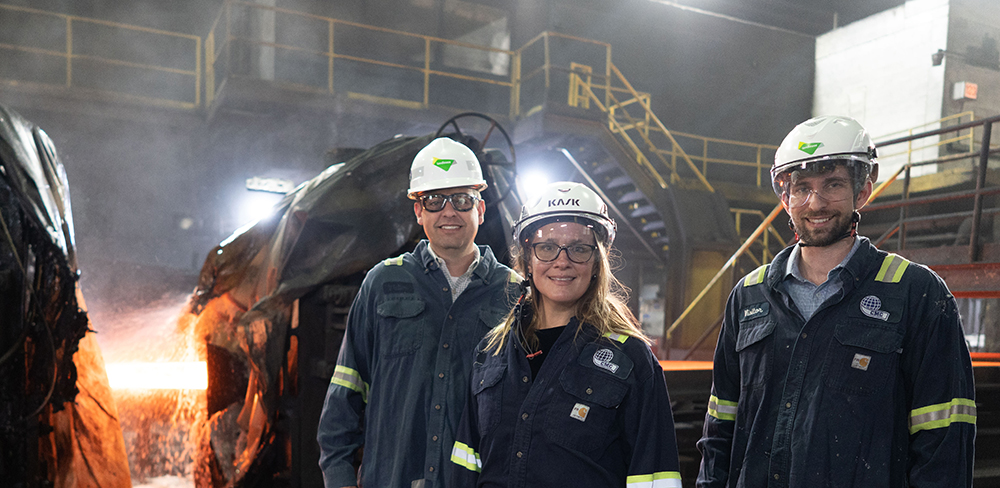
CMC steel plant in Sayreville, N.J., to observe the high-efficiency electric ARC
furnace capable of manufacturing rebar with 97% recycled steel.
Rebar from this mill supplied Claremont Hall, Central Park Tower and many other Lendlease projects.
NYREJ: Why is the environmental field, in particular, a passion of yours?
When I was at the University of Virginia, I worked on a studio project assessing the Savannah, Ga. mass transit infrastructure. We made a proposal to increase the bus stops and my professor at the time, Craig Barton, suggested we go further and add electric buses to the fleet. This resonated with the residents who were concerned about standard bus exhaust emissions. My takeaway was that whenever you seek opportunities for improvement, there are always layers of health and safety factors at play – in this case, the health of the community as well as the city’s transit system and its environmental health impacts. I have grown to consistently view sustainability through that health lens, looking for ways to build that enhance the broader community. Once we have this vantage, it makes sense to take every step possible to achieve the most sustainable, healthful, safe outcomes.
Professionally, I have worked with many modern systems that reinforced the role that technology and materials can play in building more responsibly for a healthier, whole-urban ecosystem. This includes green roofs with stormwater capture monitoring and optimization, airtightness commissioning, environmental controls and grey and black water recycling, as well as the use of bottle glass as a cement replacement in concrete to reduce embodied carbon and improve its performance and health.
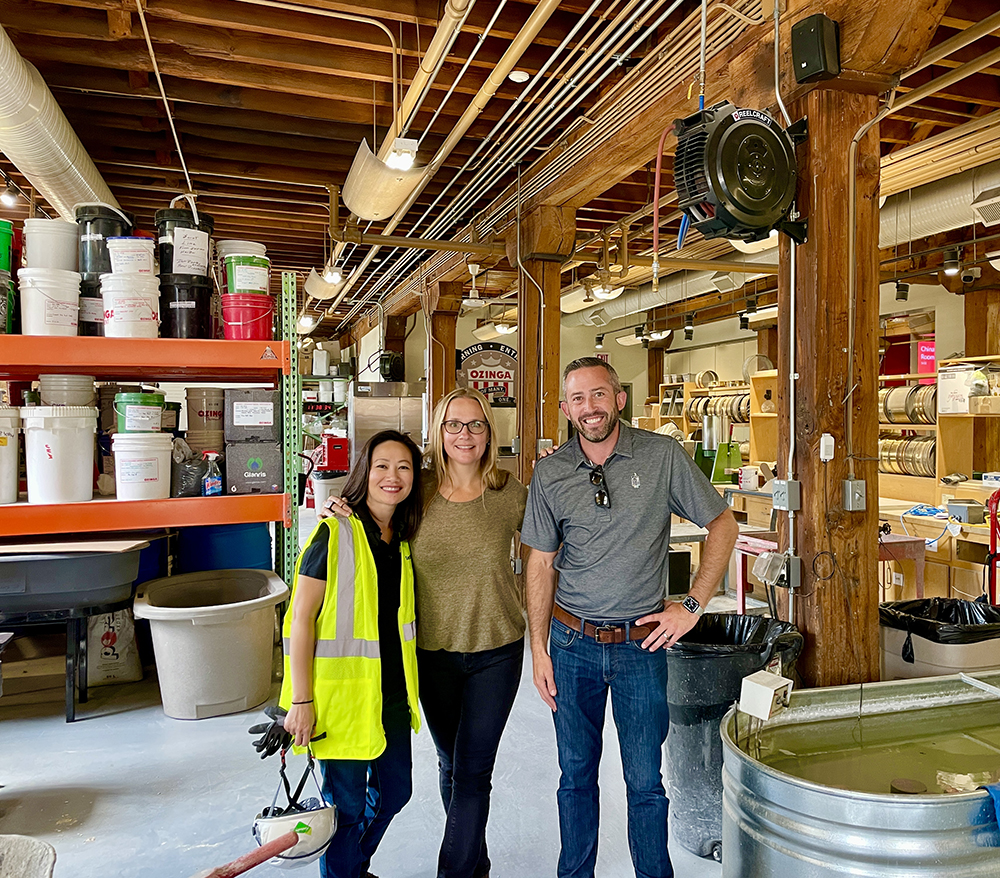
Lendlease, met with Ryan Cialdella (right) of Ozinga to discuss opportunities
to collaborate on lower-carbon concrete innovations.
NYREJ: What are the biggest challenges and opportunities for the construction industry as it copes with its impact on the environment?
There are a lot of embedded relationships – which can be a great thing about this industry, but it can also preclude us from breaking out of the status quo. New players can provide material, technologic and consulting opportunities, but there can be reluctance to work with these upstarts. That doesn’t have to be the case. We look for those breaking new ground while also working with long-term partners to revise their processes and adopt new techniques. We have a crucial role in orchestrating how that comes together without negatively affecting budget or construction schedule. This also means intensive collaboration with our design team, which I, of course, appreciate due to my architectural roots. Early and frequent conversations with the designers ensure that we make smart decisions during the procurement phase and are able to faithfully execute on the owner’s intent. Real estate is a risk-averse sector, but the right partners can help to push the envelope. When I was a consultant, we would sometimes work with more progressive city agencies willing to, for example, test out a lower-carbon concrete in a sidewalk to evaluate its performance before committing to using it in structure.
NYREJ: Lendlease has made bold ESG commitments. How is the company leading its peers when it comes to sustainability?
Lendlease has put forth some very aggressive targets with regard to social and environmental sustainability. Our Construction business unit has already met our 2025 targets to reach net zero scopes 1 and 2 and are on course to hit our 2040 goal to achieve absolute zero. Our superintendents in the field are awesomely innovative while being very careful, performing the necessary daily decision-making that keeps us moving while continually exploring new strategies that keep us on the leading edge. And it’s not just about me finding some novel technology and ordering it for the site. They are very progressive yet thoughtful and intentional about which tools and technologies to implement. This work includes exploring how we can electrify our jobsites by determining what equipment can be powered by batteries and, over time, collaborating with our partners in the region to figure out the best means of powering those batteries with renewables. By investing in sustainability, we’re able to realize better outcomes for our communities.
NYREJ: What’s next for you and Lendlease?
There has been a focus on carbon, as there should be, including operational fuels and power as well as embodied carbon in materials. What’s next is educating our partners and suppliers so they know what we are looking for. As sustainability targets get loftier, we hope to see increasing innovation to meet these goals. There has been a lot of improvement in the way that progress is tracked, and we want to see more of that.
Our industry can be myopic and focus on one trend at a time. While we have collectively been very focused on embodied carbon as an industry, we don’t want to lose sight of other important aspects of whole-system health – including material ingredient health and resource waste reduction, for example – that are synergistic with our decarbonization strategy.
MORE FROM Owners Developers & Managers
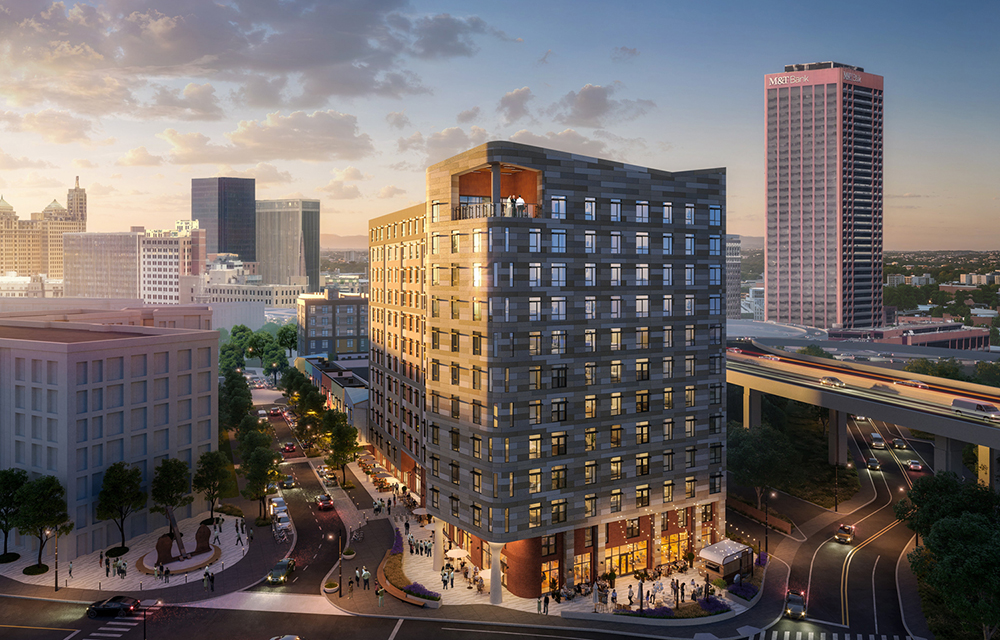
Habitat, Duvernay + Brooks and Buffalo Municipal Housing close on 254-unit first phase redev. of Marine Drive Apts.
Buffalo, NY The Habitat Company has closed on Marine Drive Apartments, officially setting in motion the redevelopment of the historic waterfront site. The project, undertaken by Habitat in partnership with Duvernay +

.gif)


.jpg)
Columns and Thought Leadership
Strategies for turning around COVID-distressed properties - by Carmelo Milio
Due to the ongoing pandemic, many landlords are faced with an increasing number of distressed properties. The dramatic increase in unemployment and reduction in income for so many has led to a mass exodus out of Manhattan, an increase in the number of empty rental units

The CRE content gap: Why owners and brokers need better digital narratives in 2026 - by Kimberly Zar Bloorian
As we head into 2026, one thing is clear: deals aren’t won by who has the best asset; they’re won by who presents it best. Yet many owners, operators, and brokers are entering the new year with outdated photos, inconsistent branding, and limited digital presence. This
.gif)