



News:
Spotlight Content
Posted: May 27, 2025
Developing Brooklyn: The Riverie
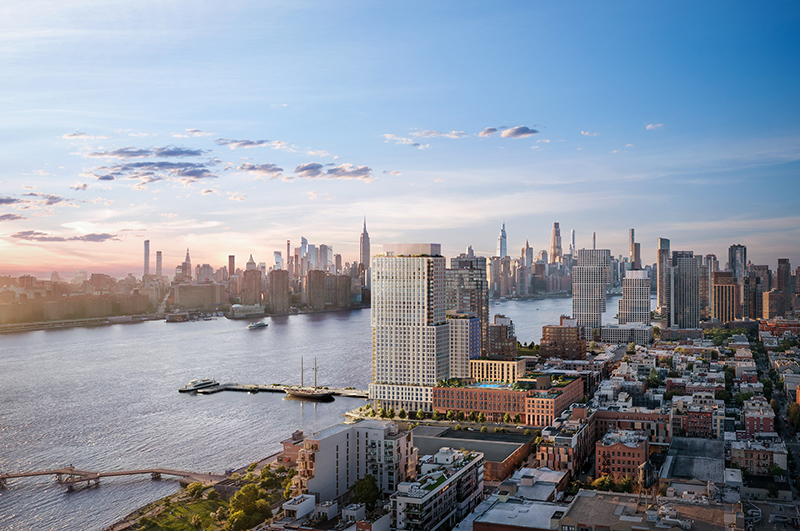
Brooklyn, NY Developed by Lendlease, The Riverie is an all-electric residential development along the Greenpoint waterfront. The project will comprise 834 residential rental units, 30% of which (251 units) have been designated as affordable housing under the Affordable New York Housing Program. Furthering the vibrancy of the waterfront and Greenpoint streetscape, The Riverie will feature approximately 14,000 s/f of ground-level retail space. Pre-leasing is slated for summer 2025, and in fall 2025, the first residents are scheduled to move in.
A newly created public waterfront esplanade reestablishes the neighborhood’s direct connection to the East River. Directly accessible from the esplanade, NYC Ferry service from the India St. Pier offers residents a five-minute commute to Midtown Manhattan.
With an emphasis on sustainability, The Riverie will be the largest residential geothermal building in New York State, according to the New York State Energy Research and Development Authority (NYSERDA). The Riverie’s vertical closed-loop geoexchange system will reduce annual carbon emissions from heating and cooling by 53% compared with typical residential systems. The Riverie will meet or exceed New York City’s Local Law 97 decarbonization legislation and Local Law 154 building electrification legislation, along with targeting LEED Gold, WEDG Waterfront, Fitwel and Energy Star certifications.
Project Team
Architects: Marvel (executive and design architect, units interior design)
Developer & General Contractor: Lendlease
Landscape Architect: James Corner Field Operations
Lobby & Amenities Interior Design: INC
Townhouses Interior Design: Crème
MEP Engineer: ARUP
Tags:
Spotlight Content
MORE FROM Spotlight Content

Over half of Long Island towns vote to exceed the tax cap - Here’s how owners can respond - by Brad and Sean Cronin
When New York permanently adopted the 2% property tax cap more than a decade ago, many owners hoped it would finally end the relentless climb in tax bills. But in the last couple of years, that “cap” has started to look more like a speed bump. Property owners are seeing taxes increase even when an


.png)


Quick Hits

.jpg)
Columns and Thought Leadership

How much power does the NYC mayor really have over real estate policy? - by Ron Cohen
The mayor of New York City holds significant influence over real estate policy — but not absolute legislative power. Here’s how it breaks down:
Formal Legislative Role
• Limited direct lawmaking power: The NYC Council is the primary

Properly serving a lien law Section 59 Demand - by Bret McCabe
Many attorneys operating within the construction space are familiar with the provisions of New York Lien Law, which allow for the discharge of a Mechanic’s Lien in the event the lienor does not commence an action to enforce following the service of a “Section 59 Demand”.

Oldies but goodies: The value of long-term ownership in rent-stabilized assets - by Shallini Mehra
Active investors seeking rent-stabilized properties often gravitate toward buildings that have been held under long-term ownership — and for good reasons. These properties tend to be well-maintained, both physically and operationally, offering a level of stability

The strategy of co-op busting in commercial real estate - by Robert Khodadadian
In New York City’s competitive real estate market, particularly in prime neighborhoods like Midtown Manhattan, investors are constantly seeking new ways to unlock property value. One such strategy — often overlooked but
.gif)