



News:
Spotlight Content
Posted: May 27, 2025
Developing Brooklyn:
Clarkson Estates
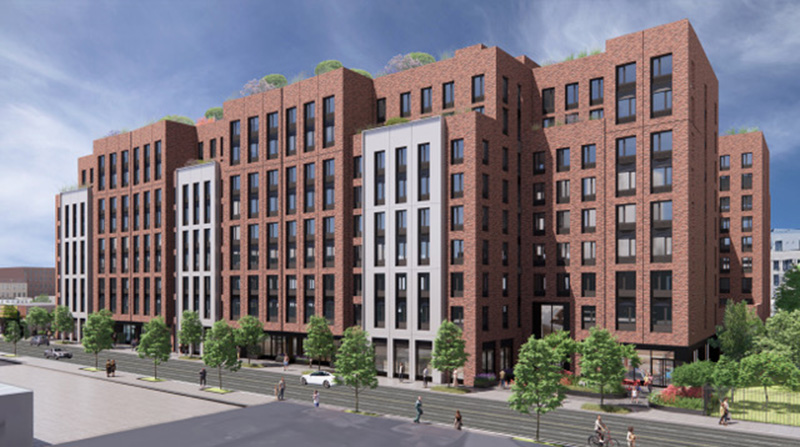
Brooklyn, NY Currently under construction in Flatbush, Clarkson Estates is a 328-unit, permanently affordable housing development by CAMBA Housing Ventures. The nine-story building, designed by architects CetraRuddy, topped out in April and when completed will also feature more than 30,000 s/f of community facility space. It is also part of New York State’s ongoing $1.4 billion Vital Brooklyn initiative, which aims to address a statewide housing shortage while improving health and quality of life for Central Brooklyn residents.
Clarkson Estates has transformed a site that was formerly underutilized as a parking lot for SUNY Downstate Medical Center into much needed workforce and supportive housing with access to healthcare services. The design features a double-height lobby at both the residential and community facility entrances with plentiful access to natural light throughout the common spaces. Amenities will include free Wi-Fi in units, 24/7 front desk security to enhance safety, extensive landscaping including courtyards and rooftop terraces to encourage community connection, a teaching kitchen for nutrition workshops, children’s playroom, computer room, indoor fitness center, laundry on every floor, flexible community rooms, bike storage, live-in superintendent, and curated art by local artists throughout the building. CHV builds amenity-rich housing to promote health and wellbeing and provide an invigorating living environment for it’s residents.
This transit-oriented development is also designed to Passive House standards, which is the highest standard for energy-efficiency, to reduce its ecological footprint, provide superior air quality, and reduce energy use and residents’ utility bills.
The building will include a photovoltaic solar array ready option, and has received funding through New York State Homes and Community Renewal’s (HCR’s) Clean Energy Initiative through NYSERDA. These sustainability measures achieve lower operating expenses, reduce the impact on our natural resources, and provide healthier buildings for the residents and neighborhood.
Project Team
Architect: CetraRuddy
Developer: CAMBA Housing Ventures Inc.
MEP Engineer: Dagher Engineering
Structural Engineer: DeSimone Consulting Engineers
Landscape Architects: Starr Whitehouse Landscape Architects and Planners PLLC
Financing: $104.8 million in New York State Housing Finance Agency Private Activity Bonds, enhanced by a $105.6 million direct-pay Letter of Credit provided by the Urban Investment Group within Goldman Sachs Asset Management. Goldman Sachs Asset Management provided $101 million in equity generated by Federal Low-Income Housing Tax Credits, syndicated by CREA, LLC, an affordable housing tax credit syndicator. New York State Homes and Community Renewal issued $77 million in subsidy which includes $2.5 million from the Clean Energy Initiative and $13.6 million from the Federal Housing Trust Fund. The New York State Office of Temporary and Disability Assistance is providing $10 million through the Homeless Housing Assistance Program, and Empire State Supportive Housing Initiative is providing rental and service subsidies for the 164 supportive units. The Federal Home Loan Bank of New York Affordable Housing Program is providing $2.5 million in support.
General Contractor: Bruno Frustaci Contracting, Inc
Tags:
Spotlight Content
MORE FROM Spotlight Content

Over half of Long Island towns vote to exceed the tax cap - Here’s how owners can respond - by Brad and Sean Cronin
When New York permanently adopted the 2% property tax cap more than a decade ago, many owners hoped it would finally end the relentless climb in tax bills. But in the last couple of years, that “cap” has started to look more like a speed bump. Property owners are seeing taxes increase even when an


.png)


Quick Hits

.jpg)
Columns and Thought Leadership

Oldies but goodies: The value of long-term ownership in rent-stabilized assets - by Shallini Mehra
Active investors seeking rent-stabilized properties often gravitate toward buildings that have been held under long-term ownership — and for good reasons. These properties tend to be well-maintained, both physically and operationally, offering a level of stability

How much power does the NYC mayor really have over real estate policy? - by Ron Cohen
The mayor of New York City holds significant influence over real estate policy — but not absolute legislative power. Here’s how it breaks down:
Formal Legislative Role
• Limited direct lawmaking power: The NYC Council is the primary

Properly serving a lien law Section 59 Demand - by Bret McCabe
Many attorneys operating within the construction space are familiar with the provisions of New York Lien Law, which allow for the discharge of a Mechanic’s Lien in the event the lienor does not commence an action to enforce following the service of a “Section 59 Demand”.

The strategy of co-op busting in commercial real estate - by Robert Khodadadian
In New York City’s competitive real estate market, particularly in prime neighborhoods like Midtown Manhattan, investors are constantly seeking new ways to unlock property value. One such strategy — often overlooked but
.gif)