



News:
Brokerage
Posted: March 22, 2022
Dabu joins TSCG NYC team

New York, NY TSCG has hired Joel Dabu, who will oversee leasing for the New York and New Jersey offices.
Dabu is a real estate executive with extensive leasing, as well as urban development and city planning expertise. Prior to joining TSCG, he was vice president of Leasing for Midwood Investment and Development, one of the city’s preeminent mixed-used real estate owners. In conjunction with his five-year stint at Taubman as a leasing agent and the Bedford Stuyvesant Restoration Corporation, Dabu brings a breadth of experience to the TSCG and SCG Retail teams.
SCG Retail, the urban division of the Atlanta-based TSCG, operates out of Manhattan. TSCG operates out of all three metro-region offices (Paramus and White Plains).
“We are really excited to add Joel to the TSCG family,” says Sam Latone, co-CEO of TSCG. “His skillset, relationships and leadership will be a tremendous value add to our team and our clients in the New York and New Jersey markets.
“Joel is a great addition to our teams in both New York and New Jersey," says David Firestein, managing partner of TSCG’s Northeast operations. “Despite all that has hit the New York Metro area, retail activity has remained robust. We’ve brought someone of Joel’s caliber on board because the region is highly desirable for both US and international companies.”
During the pandemic, Dabu worked at HR&A Advisors, one of the country’s leading real estate consultancies. At Midwood, Dabu was involved with a variety of mixed-use projects in several cities across the United States, including the lease up of the redeveloped Shops at Sportsmen’s Lodge in Los Angeles. At Taubman, Dabu worked on some of Taubman’s most important properties, including City Creek Center in Salt Lake City, Beverly Center in Los Angeles and the Mall at Short Hill in New Jersey.
“I am excited and humbled to join the incredibly talented and accomplished team at TSCG New York,” says Dabu. “Working collaboratively with them, I look forward to bolstering real estate’s recovery from the pandemic and beyond by filling space with new, high-quality retailers that will anchor vibrant communities across the region.”
Dabu spent a year in Germany studying European commercial real estate trends as part of the prestigious German Chancellor Fellowship. He speaks German, Spanish, French and some Arabic. He is a graduate of George Washington University and has an MBA from the University of Michigan.
Tags:
Brokerage
MORE FROM Brokerage
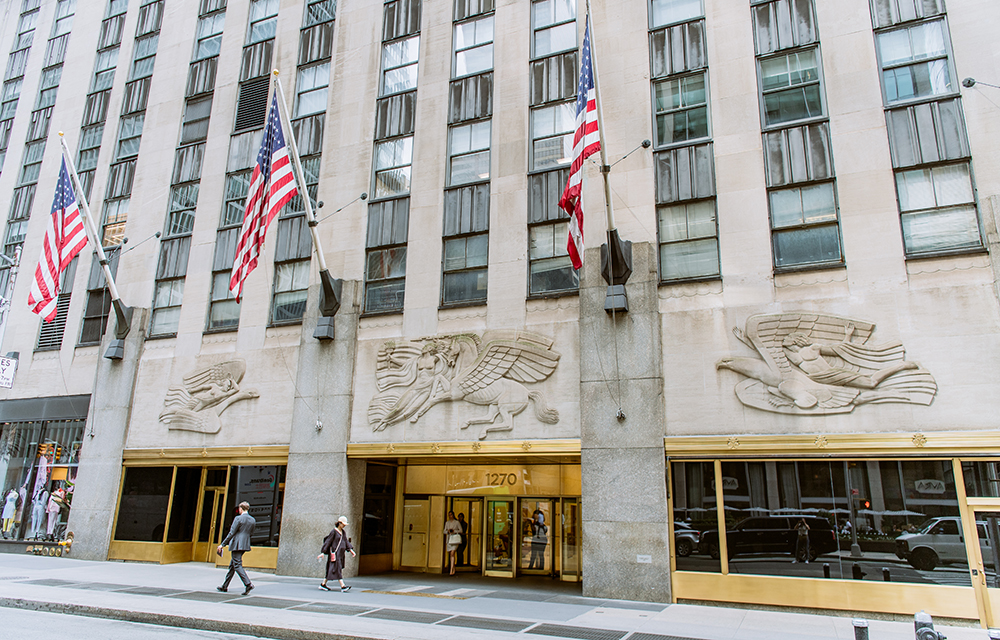
Horizon Kinetics relocates new headquarters to Tishman Speyer’s Rockefeller Center
Manhattan, NY According to Tishman Speyer investment boutique Horizon Kinetics Asset Management LLC will relocate its current New York office to 18,713 s/f on the 27th floor of 1270 Avenue of the Americas at




.jpg)

.gif)
Columns and Thought Leadership
AI comes to public relations, but be cautious, experts say - by Harry Zlokower
Last month Bisnow scheduled the New York AI & Technology cocktail event on commercial real estate, moderated by Tal Kerret, president, Silverstein Properties, and including tech officers from Rudin Management, Silverstein Properties, structural engineering company Thornton Tomasetti and the founder of Overlay Capital Build,

Behind the post: Why reels, stories, and shorts work for CRE (and how to use them) - by Kimberly Zar Bloorian
Let’s be real: if you’re still only posting photos of properties, you’re missing out. Reels, Stories, and Shorts are where attention lives, and in commercial real estate, attention is currency.

Strategic pause - by Shallini Mehra and Chirag Doshi
Many investors are in a period of strategic pause as New York City’s mayoral race approaches. A major inflection point came with the Democratic primary victory of Zohran Mamdani, a staunch tenant advocate, with a progressive housing platform which supports rent freezes for rent

Lasting effects of eminent domain on commercial development - by Sebastian Jablonski
The state has the authority to seize all or part of privately owned commercial real estate for public use by the power of eminent domain. Although the state is constitutionally required to provide just compensation to the property owner, it frequently fails to account
.gif)