



News:
Owners Developers & Managers
Posted: June 14, 2022
Community Preservation Corp. adds $20 million to ACCESS Initiative
New York, NY The Community Preservation Corp. (CPC), a leading nonprofit multifamily housing finance company, unveiled an additional $20 million in funding for its Acquiring Capital and Capacity for Economic Stability and Sustainability (ACCESS) initiative which offers funding, technical, and educational support to black and indigenous people of color (BIPOC) developers and real estate entrepreneurs, and targets high-quality housing projects in communities of color.
Since ACCESS’s 2020 launch, the demand for the funding and support services provided through ACCESS have exceeded CPC’s initial $20 million investment. This new round of funding brings CPC’s total investment in advancing racial equity and diversity in the real estate development industry through its ACCESS initiative to $40 million.
“CPC is proud to double its commitment to brown and black real estate entrepreneurs by increasing our ACCESS program to $40 million,” said Sadie McKeown, president, CPC. “CPC’s mission is to support real estate investments that make low and moderate-income neighborhoods thrive. Increasing our commitment to ACCESS provides developers of color capital products and support that meet their unique needs and allows them to further their investment and impact in communities.”
“The need to add another $20 million to ACCESS less than two years in shows that there’s a significant underserved and underrepresented population of Black and brown developers who are poised for growth, and just need the opportunity and access to the right resources. If ACCESS can be that hand-up, or that connection to capital and knowledge that is going to help take their business to the next level - that is the measure of success for us,” said Lawrence Hammond, senior vice president, director of ACCESS.
Now in its second year, CPC’s ACCESS initiative has provided $8 million to support eight BIPOC developers across nine investments for multifamily projects throughout New York State. There is also a robust pipeline of projects currently under consideration, including $21 million of active opportunities supporting an additional 16 BIPOC entrepreneurs and 21 investments. Overall, the funded projects and those in the active pipeline represent a total of 30 investment opportunities (totaling $29 million), comprising 24 BIPOC developers. This includes projects in New York City, Rochester, Poughkeepsie, Albany, and Syracuse where ACCESS funding has been used for pre-development, acquisition, construction and renovation, bridge financing, equity investments and more. Notable projects include:
- Garfield and Shereen Salmon celebrated the renovation of a long-vacant, mixed-use building with five apartments above a ground-floor cafe in Poughkeepsie with a ribbon-cutting ceremony in January; and
- Patricia Cruz-Irving and Paul Irving renovated a 33-unit residential building in Rochester, NY allowing them to rehabilitate the property and transform it into high-quality, affordable housing.
In addition to capital support, ACCESS offers education and training opportunities through roundtable discussions, panels, and informational presentations on a host of topics. ACCESS also seeks to create and foster relationships with government partners and other private and nonprofit organizations to leverage shared resources, create new programs, and engage in policy discussions to help create positive change and level the playing field. Two key relationships formed through ACCESS included a joint venture with TruFund Financial Services and the creation of a new affordable housing program in partnership with the State of New York’s affordable housing agency.
The $6 million joint venture between CPC and TruFund is facilitating affordable capital to support New York State-based emerging BIPOC developers to build their capacity and grow their business infrastructure. Funding provided through the program can be used to acquire, develop, finance, operate, improve, preserve, sell, and dispose of private and publicly financed affordable housing and community development investments within the state. Each project must meet the needs of low- to moderate-income communities or residents and enhance the capacity and progress of BIPOC owned businesses.
Through ACCESS, CPC is partnering with New York State Homes and Community Renewal (HCR) to launch the Legacy Cities program which transfers portfolios of blighted, land bank-owned one- to four-family properties to local developers with a preference for Minority and Women-owned Business Enterprises (M/WBEs). Following rehabilitation, sales will prioritize purchasers of color and low-income households, helping to tackle the issue of generational wealth building through homeownership.
MORE FROM Owners Developers & Managers
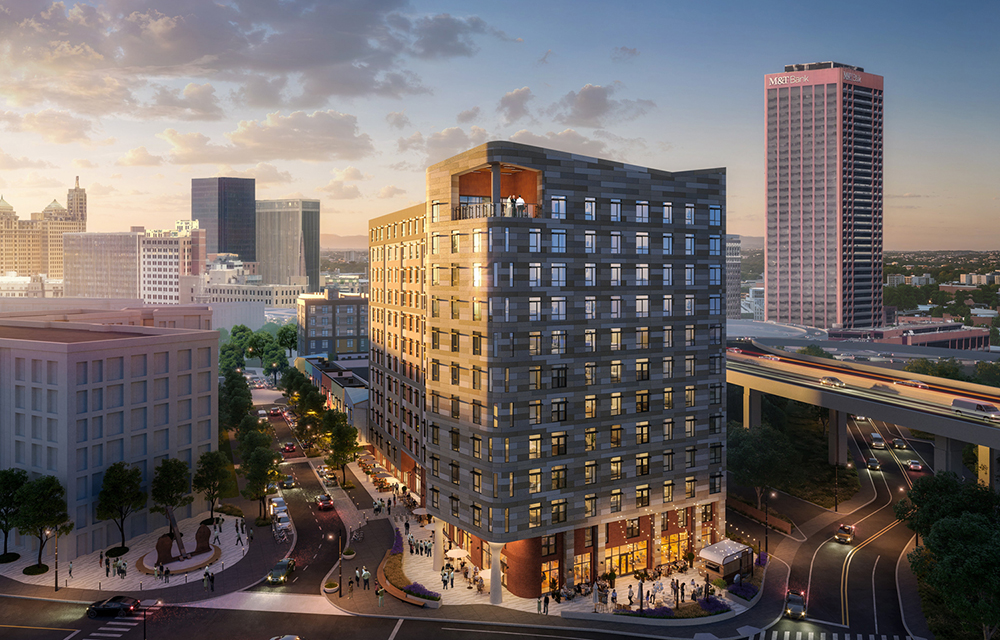
Habitat, Duvernay + Brooks and Buffalo Municipal Housing close on 254-unit first phase redev. of Marine Drive Apts.
Buffalo, NY The Habitat Company has closed on Marine Drive Apartments, officially setting in motion the redevelopment of the historic waterfront site. The project, undertaken by Habitat in partnership with Duvernay +

.gif)

.gif)
.jpg)
Columns and Thought Leadership
Strategies for turning around COVID-distressed properties - by Carmelo Milio
Due to the ongoing pandemic, many landlords are faced with an increasing number of distressed properties. The dramatic increase in unemployment and reduction in income for so many has led to a mass exodus out of Manhattan, an increase in the number of empty rental units

The CRE content gap: Why owners and brokers need better digital narratives in 2026 - by Kimberly Zar Bloorian
As we head into 2026, one thing is clear: deals aren’t won by who has the best asset; they’re won by who presents it best. Yet many owners, operators, and brokers are entering the new year with outdated photos, inconsistent branding, and limited digital presence. This
.gif)