



News:
Movers & Milestones
Posted: November 11, 2025
Artificial intelligence takes center stage at CREtech New York 2025

Manhattan, NY Artificial intelligence dominated the conversation at this year’s CREtech New York, shaping discussions across every corner of commercial real estate, from site development and acquisitions to asset management, tenant engagement, and construction. Industry leaders explored how AI is transforming workflows by streamlining deal sourcing, automating back-end operations, enhancing data-driven decision-making, and accelerating project feasibility analysis. Each session offered practical insights for executives eager to leverage emerging technologies to stay competitive in a rapidly evolving marketplace.
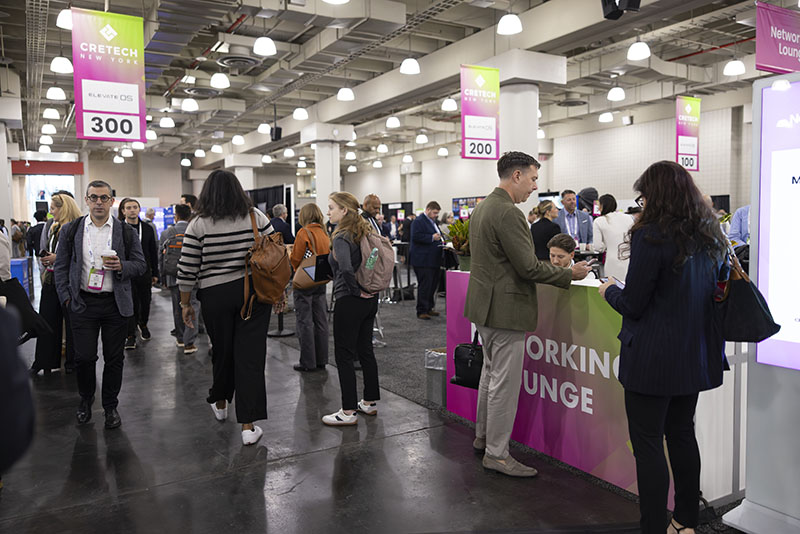
Now in its eighth and largest year, CREtech NYC filled the Javits Center with an unmistakable sense of momentum. More than 3,000 industry professionals, 110 sponsors, and 26 panels spread across two stages created an atmosphere that felt less like a conference and more like a laboratory of innovation. The event underscored the sector’s appetite for progress and its increasing fluency in technology.
Notably, many exhibitors were former real estate professionals turned founders, exemplifying the Founder–Market–Fit concept that has come to define the new wave of proptech entrepreneurship. Equally telling was the caliber of ownership in attendance.
Michael Rudin (Rudin), Alexander Durst (The Durst Organization), Steven Yaloff (Tanger), Cathy Marcus (PGIM), Andrew Holm (ARES), and Toby Bozzuto (Bozzuto Group) joined a roster of additional C-suite executives from Jamestown, Tishman Speyer, BXP, AvalonBay, Prologis, and Related. Their presence reinforced that technology has moved from the periphery to the center of strategic decision-making in commercial real estate.
Among the standout discussions was a panel exploring how AI can amplify human capability, helping companies scale intelligently without inflating headcount. Speakers agreed that while AI enhances efficiency and insight, human judgment, empathy, and adaptability remain critical as the technology continues to mature.
That spirit of innovation carried over to the exhibition floor, where AI was the common thread tying together a room buzzing with possibility. From established players to the rising startups featured in the event’s dedicated Start-Up Zone, CREtech 2025 showcased a clear message: artificial intelligence is no longer a distant disruptor but the driving force shaping the future of CRE.
The exhibition floor reflected the extraordinary range of innovation now defining CRE technology. From intelligent asset management systems to next-generation mobility, sustainability, and building experience tools, the startups and established firms in attendance showcased how deeply AI and data integration are reshaping the industry’s operational backbone.
Some platforms focused on the infrastructure of buildings and portfolios. Switch, for instance, has already deployed more than 25,000 EV chargers across 3,000 properties, using AI to identify the most profitable and efficient locations for installation. This capability is becoming critical as electric mobility moves to the center of asset strategy. AppSpace demonstrated how simple sensory data can unlock real-time insights into office utilization and workplace experience, empowering tenants and operators to better align design with behavior. Meanwhile, VendorPM showed how lifecycle vendor management is evolving beyond compliance into strategic optimization, offering a marketplace model that connects 70,000 vendors to more than 11,000 buildings.
One of the most talked-about moments came from Outcome, which chose CREtech New York as the stage to emerge from stealth after 14 months in private alpha. Founded by the team behind Rise Buildings, Outcome introduced its purpose-built AI platform for asset managers and acquisitions teams. The modular system is designed to integrate seamlessly with existing workflows rather than replace them. Its debut underscored a growing trend at the conference: technology that enhances how CRE professionals work rather than forcing them to adapt to it.
Beyond these standout names, the breadth of solutions on display was striking. Companies presented tools for automating development feasibility, optimizing floor plans in seconds, predicting tenant demand, and analyzing mobility patterns through anonymized data streams. Collectively, they painted a picture of a market that is no longer experimenting with innovation but actively putting it to work.
The energy across the floor was unmistakable. Commercial real estate is no longer standing on the sidelines of digital transformation; it is building the playbook.
MORE FROM Movers & Milestones

Rosenberg & Estis secures Article 78 victory
Manhattan, NY Rosenberg & Estis, P.C. has achieved a successful Appellate Division ruling overturning an administrative court decision and remanding the original matter for review.




.gif)


.gif)
.jpg)
.gif)