



News:
Construction Design & Engineering
Posted: September 22, 2020
Advanced filtration: Healthy indoor air without the energy penalty - by Doug Engel

Building owners are employing a myriad of enhancements to adapt their office settings to mitigate the transmission of COVID-19.
While deep cleaning, temperature scans and other measures are all important, the latest advances in research on the novel coronavirus has led experts to evolve their thinking on priority mitigation practices. The most urgent concern is now focused on how to address airborne droplets (bioaerosols) that linger far longer in the air than was originally suspected. The HVAC system–and supporting ventilation and filtration strategies–have become the front line protective mechanism that building managers can employ to ensure their facilities are safe for workers to return to their offices.
Experts’ HVAC recommendations have evolved to correspond with the latest COVID-19 research. Initially the focus was on maximizing outside air ventilation, however, it quickly became clear there were significant downsides to this approach, specifically HVAC system limitations and the high energy penalty associated with that strategy.
Conditioning of outside air to achieve a comfortable temperature and humidity is the largest cost of operating a commercial HVAC system. The more conditioning that must be done, the more energy is used. This makes maximizing outdoor air both a costly strategy and one that exacerbates a building’s carbon footprint, a growing concern for companies as they adopt sustainability goals and seek to avoid GHG penalties soon to be imposed by measures like Local Law 97.
William Bahnfleth, chair of the American Society of Heating, Refrigerating and Air Conditioning Engineers’ (ASHRAE) Epidemic Task Force shared some illuminating research in a recent webinar entitled “Fundamentals of COVID-19 Risk Management.” Professor Bahnfleth, who also teaches Architectural Engineering at Penn State, showed that the mean relative risk of infection can be reduced equally by filtration or by ventilation. According to professor Bahnfleth, “Achieving the same relative risk of infection using ventilation is much more costly [than filtration], primarily due to the energy cost of increased ventilation rates.” The infection risk reduction associated with the use of higher-efficiency filters (represented by higher Minimum Efficiency Reporting Values, or MERV ratings) is almost entirely consistent regardless of the number of air changes once filters are at the high efficiency level.
ASHRAE updated its Commercial Guide in late August to reflect these considerations, and recommends the following strategies:
- If there are significant energy impacts from increasing outside air for ventilation, use minimum outside air as required by ASHRAE Standard 62.1 with a minimum MERV-13 filter.
- If outdoor air quality is not healthy per Section 4 of ANSI/ASHRAE Standards 62.1-2019, especially high particulate matters, do not open windows or increase ventilation without using the proper filters.
- Maintain relative humidity between 40% and 60% where possible.
- Consider portable air cleaners when a room has insufficient outside air per code requirements and filtration is below MERV-13.
- Consider UVC light as an enhancement where spaces require additional measures, e.g., spaces that serve vulnerable occupants, or when MERV-13 filtration or 100% outside air are not possible, etc.
Enhanced filtration is a critical solution to the challenge of maintaining healthy indoor air quality, however it’s not always easy. In older facilities, an existing HVAC system may not be able to handle upgrading to a higher efficiency filter. For these situations ASHRAE has recommended in-room, high-efficiency filtration units.
Additionally, there is increasing focus on addressing spaces that have a heavy bioburden, such as entryways, conference rooms, elevators and kitchen/lounge areas. In these spaces, local filtration units that can address viral contaminants at the source are also being recommended.
According to ASHRAE these in-room units should be centrally located in the space and be situated so as to not blow directly on room occupants. Ceiling-mounted units with high-efficiency filters that operate independently of the HVAC system address these concerns without adding substantial cost or stressing the system. Installed off the floor and out of the way, they aren’t a distraction with snaking cords and fan noise. They can’t be easily removed or unplugged like portable units can and they sometimes even include UV lights that kill any viral particles that might be caught on the filters so that they can be safely replaced at any time.
Many experts now recommend an “all of the above” approach to viral remediation within office settings. With supplemental air purifiers, enhanced filtration can be added to whatever filtration and ventilation approach is practical. In choosing air purifiers, keep these pointers in mind:
- Look for independent testing that has verified that purifiers work as they claim.
- Look for ceiling-mounted units to prevent tripping hazards or unplugging and moving units in a busy shared space or conference room.
- Select sturdy and durable commercial- or industrial-grade units, not residential products.
- Pay attention to the number of air changes per hour (ACH) the units will deliver, and make sure that together with the existing HVAC system, they will bring the facility to the recommended five ACH to keep the viral load low. More than one unit may be required to adequately treat the space.
- Be sure that ceiling-mount purifiers have wall-mounted control panels for ease of management.
- Consider the reassurance that seeing an air filter installed below the ceiling might provide to building occupants. Although just as effective when installed in the plenum, a visible air purifier may offer peace of mind.
Protecting building occupants from COVID-19 infection is priority one for building owners and their tenants. Building owners can breathe a little easier knowing they are protecting building occupants with advanced filtration strategies without the enormous energy penalty associated with high outside air ventilation.
Doug Engel is SVP, sales & marketing for enVerid Systems, Boston, MA.
MORE FROM Construction Design & Engineering
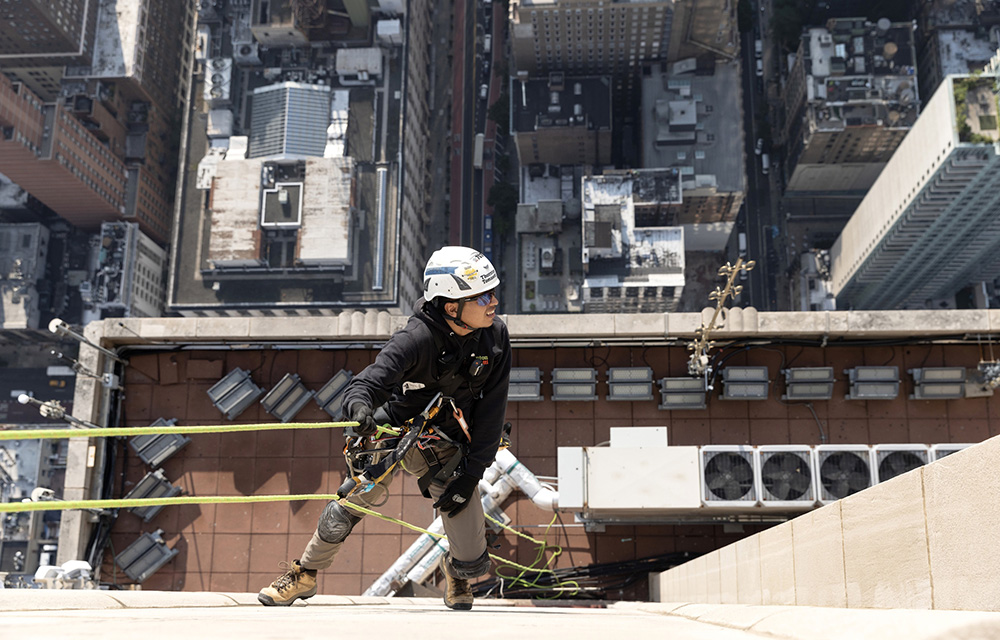
NYC mayor and DOB release comprehensive façade inspection and safety study conducted by Thornton Tomasetti
Manhattan, NY New York City mayor Eric Adams and New York City Department of Buildings (DOB) commissioner Jimmy Oddo released the full recommendations from a comprehensive engineering study conducted by global engineering firm Thornton Tomasetti

.gif)
.jpg)

.gif)
.gif)